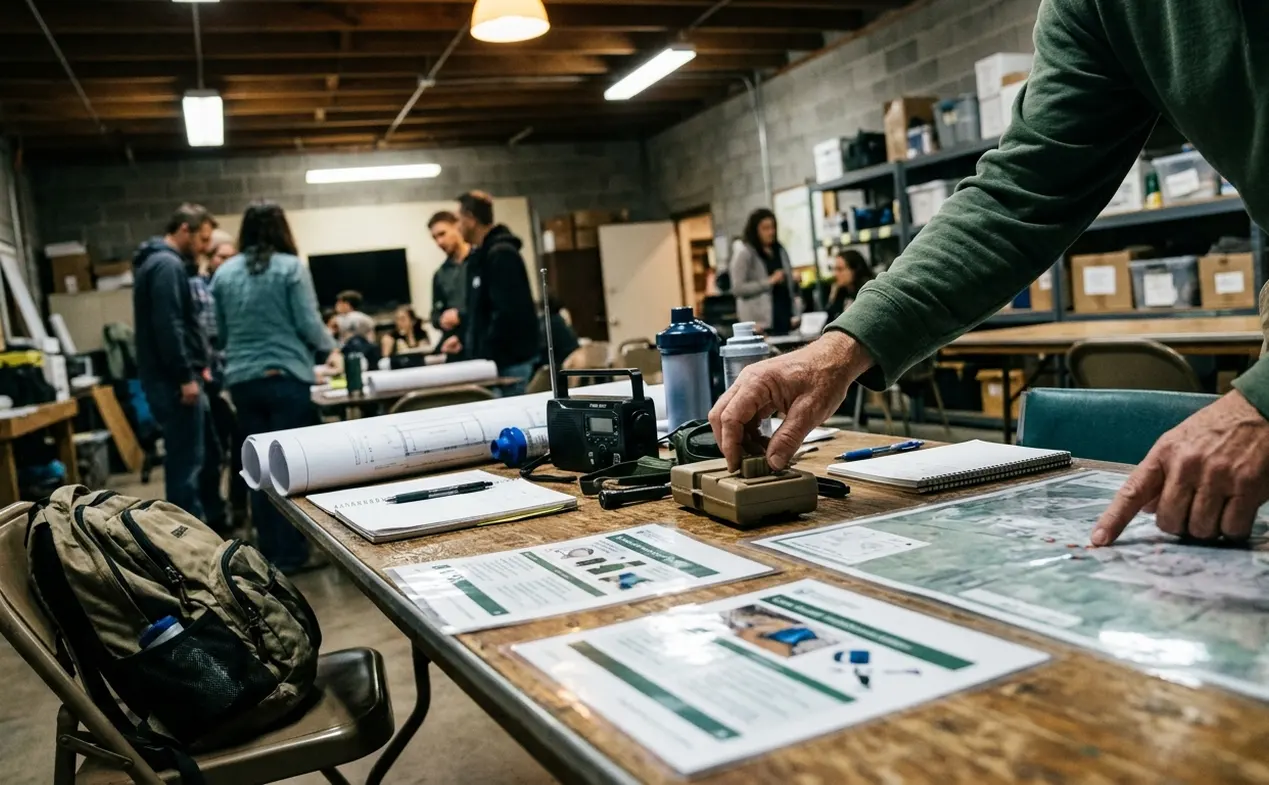
Key Takeaways for the Seminar
Summary: This university seminar module helps students analyze refugee camps as interconnected systems rather than isolated crises. Its purpose is not to make students feel pity and stop there. It moves them from emotional engagement into disciplined mapping: displacement journey, camp arrival, service access, Watsan pressure points, cholera risk, and durable solutions such as voluntary repatriation, local integration, or resettlement.
The strongest version of the module begins with the refugee journey, then asks what that journey does to camp systems. A family arriving after flight from danger does not enter a neutral space. They enter a registration process, a water queue, a shelter allocation system, a food distribution schedule, a clinic pathway, and a governance structure that may or may not function under pressure.
That sequence matters because students often notice the visible hardship first.
The learning arc was deliberately structured to bridge the gap between empathy and technical rigor. In practice, that means the seminar can start with a short narrative exercise, but it should end with students explaining why one damaged pump, one poorly placed VIP latrine, or one blocked drainage channel can change health risk across a whole section of camp.
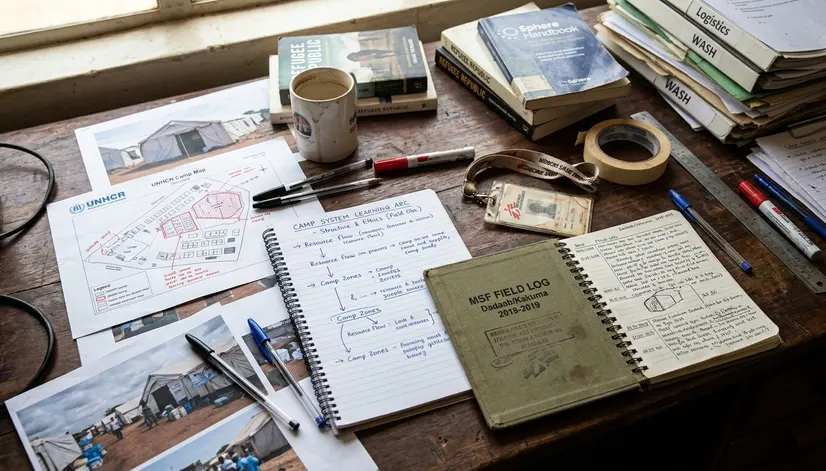
What students should be able to do by the end
- Describe a refugee camp as a temporary settlement shaped by movement, registration, access, services, and authority.
- Separate visible problems from system failures.
- Use Watsan terminology accurately when discussing water, sanitation, hygiene, drainage, and waste.
- Connect cholera risk to water and sanitation breakdown without inventing outbreak figures.
- Rank response priorities and state the constraint that could stop each action from working.
What This Seminar Module Is Designed to Teach
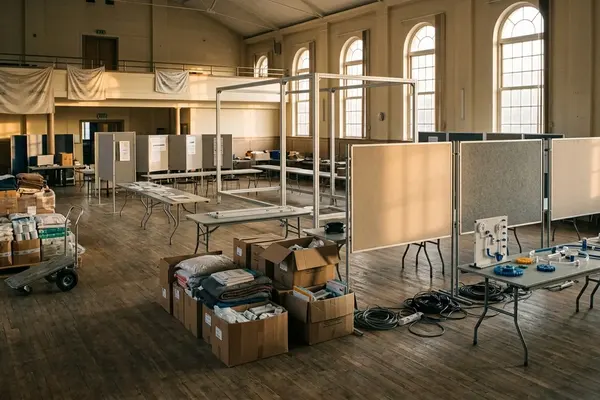
This is a foundational teaching unit for students studying refugee camp realities, humanitarian response, public health, or emergency logistics. It is not a documentary discussion guide, although documentary material can support it. It is closer to a systems walkthrough: students learn to read a camp as a set of linked functions under stress.
A camp should not be taught as a single place of shelter. Shelter is one layer. The full settlement is shaped by displacement routes, border or internal movement, legal status, registration, water access, sanitation, food distribution, health care, protection, host-community relations, and camp governance.
Operational thinking, not field imitation
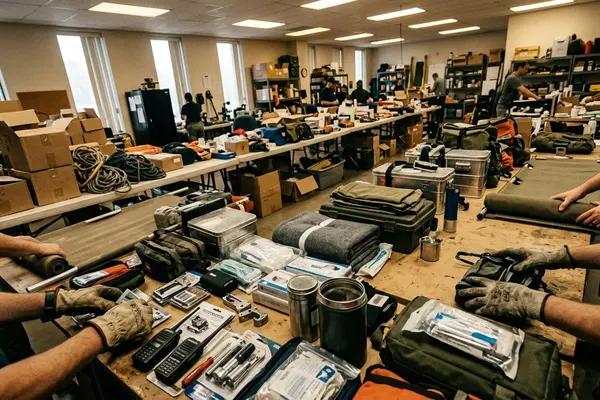
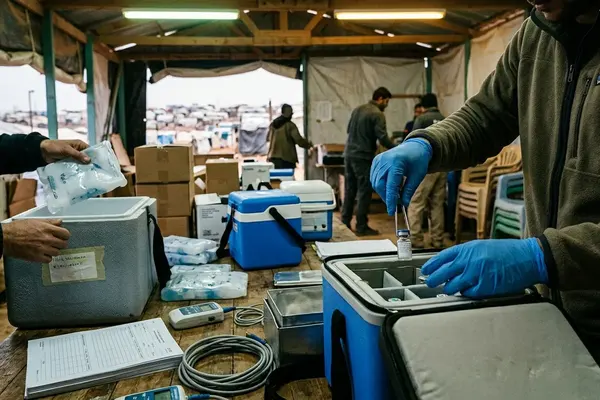
MSF-style field logistics provides a useful reference point because it forces students to think in operational sequences. What supplies arrive first? Which roads are passable? Which patients need triage? Which staff can move safely? Which service must continue even when fuel, security, or cold chain capacity is weak?
In emergency logistics, the first two to three days of rapid assessment often shape what responders can realistically do next. In a classroom, that time frame should not become a dramatic countdown exercise. It should become a constraint: students have incomplete information, limited access, and several urgent needs competing at once.
Note: The module works best when students compare two settings rather than memorize one camp template: an urban displacement setting where refugees are dispersed among host communities, and a closed, geographically isolated rural camp where service delivery is concentrated but access may be tightly controlled.
Using Empathy-Based Learning Without Losing Analytical Discipline
Empathy-based learning is the entry method, not the final lesson. The point is to help students understand the refugee journey before they examine the camp systems that receive displaced people.
The sequence can be taught plainly: flight from danger, border crossing or internal displacement, temporary shelter, registration, service access, uncertainty, and possible resettlement. That sequence gives students a human frame for later technical mapping.
The curriculum committee initially considered live-action role-play simulations to teach the refugee journey, then rejected that approach because trauma should not become a classroom performance. A better method is quieter and more controlled: a 10- to 15-minute reflective writing prompt before the technical mapping begins.
From narrative to analysis
The reflective prompt should ask students to track decisions, not act out suffering. Who controls movement? Where does information come from? Which document is missing? What happens if a child needs care before registration is complete?
After that, the seminar changes register. Students move from individual experience to population-level implications. A delayed registration process may affect food entitlement. Unclear service maps may increase protection risks. Poorly explained clinic referrals may overload the wrong point of care.
The United States can be named as one possible destination for refugee resettlement, but the wording must stay careful. Resettlement is only one durable solution, and it is not guaranteed for most displaced people.
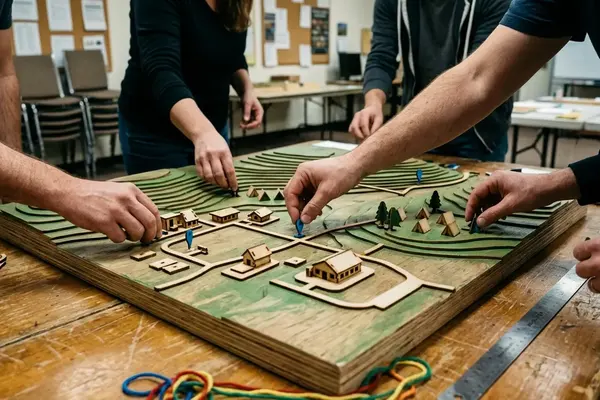
Quick Tip: Ask students to underline every place in the journey where a person depends on a system they do not control. Those marks become the first draft of the camp systems map.
Task I: Identifying Problems in the Camp Setting
Task I should be framed around identifying problems in setting. That phrase sounds simple, but it is where many students rush too quickly. The assignment should require observation categories before any proposed solution appears.
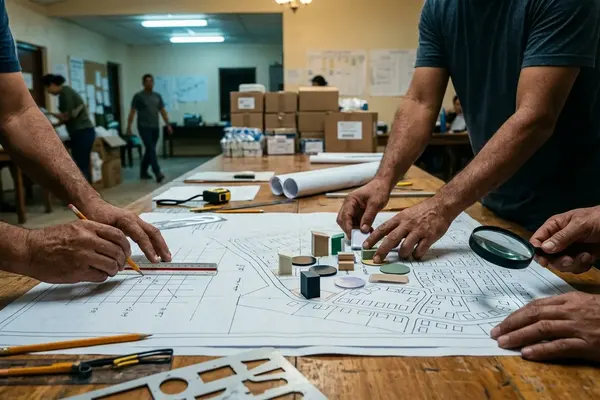
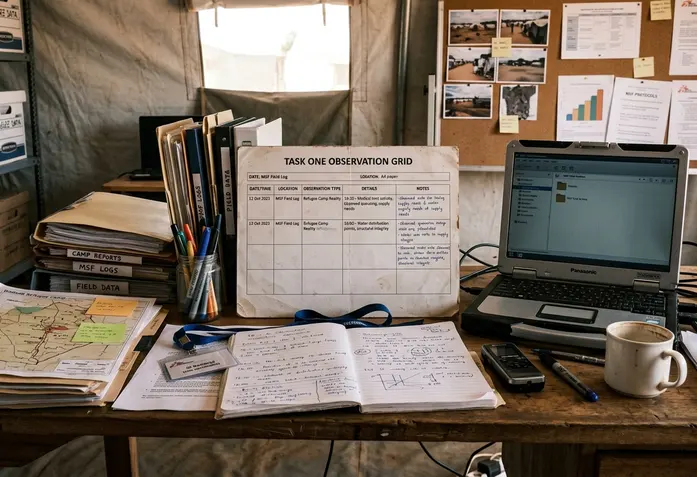
Students begin with shelter density, water points, sanitation access, drainage, waste disposal, food queues, clinic access, referral pathways, and security concerns. Each category should be recorded as an observation, a possible system failure, and an evidence gap.
Visible problem versus system failure
A long water queue is a useful example because it looks obvious and still resists easy diagnosis. Students may treat it solely as a supply volume issue when the root cause is a damaged distribution pump. Another group may blame household storage containers, when the access route to the water point is unsafe after dark.
The better classroom answer compares causes. Long queues may reflect too few water points, poor distribution timing, damaged pumps, insufficient maintenance staffing, uneven shelter layout, or protection risks along the route.
WASH standards often discuss minimum daily water quantities for drinking, cooking, and hygiene, but the classroom exercise should not stop at volume. A camp section can meet a planning figure on paper and still fail people if distribution points are too far away, taps break, or people avoid the route because it passes an unlit area.
- Name the visible problem.
- List at least three possible system causes.
- Identify what evidence would distinguish those causes.
- State which population is most affected.
- Describe the immediate risk if no action is taken.
Watsan, Sanitation Breakdown, and Cholera Risk
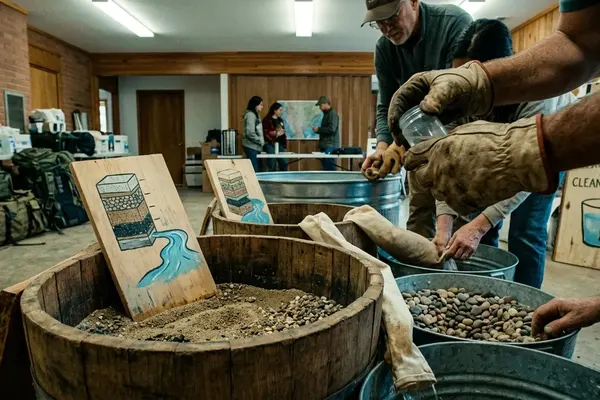
Watsan is relief worker shorthand for water and sanitation. In a camp seminar, it should be treated as a core systems topic rather than a technical side note.
Water access, latrine placement, drainage, handwashing stations, waste management, and hygiene messaging all connect to public health outcomes. When one part weakens, another part carries more pressure. Poor drainage can contaminate walking routes. Full latrines can change defecation practices. Missing soap can weaken hygiene messaging even when the message itself is accurate.
Why cholera is the case example
Cholera is a clear water-borne disease example for teaching because its transmission pathways show how sanitation breakdown can cascade through a settlement. The module should use cholera to explain risk pathways, not to frighten students with unsupported numbers.
For example, latrine siting is not only a construction question. It is a groundwater protection question, a dignity question, and a maintenance question. VIP latrine placement, desludging access, handwashing availability, and user safety need to be read together.
Students can consult CDC cholera guidance for disease background, but the classroom discussion should still return to camp systems: where water is collected, where waste moves, who cleans shared facilities, and how quickly a broken facility is reported.
One constraint: do not let students write that cholera will occur simply because a camp is crowded. The stronger claim is narrower: sanitation breakdown and unsafe water pathways can increase cholera risk, especially where surveillance, treatment access, and hygiene infrastructure are weak.
Task III: From Problem List to Response Priorities
TASK III should be handled as an applied synthesis task. The source phrase is incomplete, so the seminar should not invent a missing assignment prompt. Instead, it should ask students to move from the Task I problem list into ranked response priorities.
This mirrors the pressure of humanitarian cluster coordination meetings, where teams must justify triage priorities against logistics, security, staffing, and public health constraints. The exercise is not about producing the perfect plan. It is about making the trade-offs visible.
Required response structure
Students should choose two or three priority problems from Task I and justify the order of response. Each proposed action must name the affected population, responsible sector, dependency, likely constraint, and immediate safeguard.
- Affected population: Identify who faces the highest immediate risk, such as new arrivals, children, older people, people with disabilities, or households far from water points.
- Responsible sector: Link the action to WASH, health, shelter, logistics, protection, food assistance, or camp coordination.
- Dependency: State what another team must provide, such as fuel, security access, water trucking, spare parts, referral transport, or cold chain support.
- Likely constraint: Name the limit that could slow the action, including access restrictions, staffing gaps, damaged infrastructure, supply delays, or community mistrust.
- Immediate safeguard: Identify what can reduce harm while the larger fix is underway.
For a protracted emergency phase, instructors can introduce 3- to 6-month operational planning cycles as a way to distinguish immediate safeguards from medium-term service repair. A temporary handwashing station, for instance, is not the same as a durable sanitation plan. Both may be necessary, but they answer different time horizons.
Summary: Task III tests whether students can defend priorities without pretending that every urgent problem can be solved first.
Scope, Evidence Boundaries, and Safe Classroom Use
This article provides a teaching architecture for a university seminar. It is not an operational manual for field deployment, and students should not leave the room thinking a classroom map qualifies them to run a camp response.
Camp conditions vary by country, legal status, geography, host-community relationship, conflict dynamics, and response capacity. A closed rural camp with controlled entry, a transit site near a border, and an urban displacement pattern inside a host city will produce different service problems even when the humanitarian vocabulary looks similar.
Evidence discipline
Strict evidence boundaries matter. The seminar should not include statistics, mortality estimates, disease rates, or resettlement figures unless students can cite a named source. “People say” is not a source. A slide copied from another presentation is not enough unless the original source can be checked.
Monitoring reports show only what their methods are able to capture, and classroom interpretation should say that out loud. One catch: this teaching framework assumes a baseline level of academic freedom and access to external public health literature, which may be restricted in some institutional or regional contexts.
The safest classroom practice is to separate three categories on the board: confirmed facts, reasonable inferences, and unanswered questions. Students can argue within those boundaries without turning uncertainty into false certainty.