Key Takeaways for Field Use
Summary: Slow sand filtration fits camp WASH planning when raw water is reasonably clear, operators can maintain slow continuous flow, and the treatment site can be protected from animals, runoff, and unauthorized dipping. It relies on biological and mechanical pathogen reduction, especially through the biological skin at the sand surface. It should not be treated as a stand-alone guarantee of safe water: source protection, clean transport containers, safe storage, and possible chlorination remain part of the same chain.
- Use slow sand filtration for low-turbidity water where a stable operating team can protect the filter surface.
- Keep flow slow enough for contact time; typical operating ranges are 0.1 to 0.3 meters per hour.
- Allow the biological skin, or schmutzdecke, to mature before expecting full pathogen reduction.
- Plan disinfection after filtration where cholera, typhoid, or other epidemic risks are present.
- Treat jerrycans, buckets, and collection behavior as part of water quality control, not as an afterthought.
In field terms, the filter is not the whole water system. It is one controlled step between a raw source and a drinking cup.
Where Slow Sand Filtration Fits in Camp Water Safety
Slow sand filtration is a camp water treatment method that passes water slowly through a prepared sand bed, using storage time, fine media, and biological activity to reduce pathogens. The method looks simple from the outside: water enters, rests above the sand, passes down through the bed, and leaves through an underdrain. The working part is less visible. A living surface layer develops at the top of the sand and becomes central to treatment performance.
Its role sits between source control and final protection. A practical camp sequence may include protected source selection, catchment improvement, sedimentation, filtration, chlorination, safe collection, and household storage. Removing any one of those controls shifts pressure onto the others.
When selecting filtration for emergency camps, planners may compare slow sand filtration with rapid sand filtration. Rapid systems can move water faster, but they require continuous chemical coagulation and backwashing infrastructure. In a camp where fuel, spare parts, trained operators, and wash-water disposal are uncertain, that requirement can become the deciding constraint.
This article is a method guide, not a universal design manual. The dimensions, loading rate, and operating schedule still need site-specific engineering review, especially where population movement changes demand from week to week.
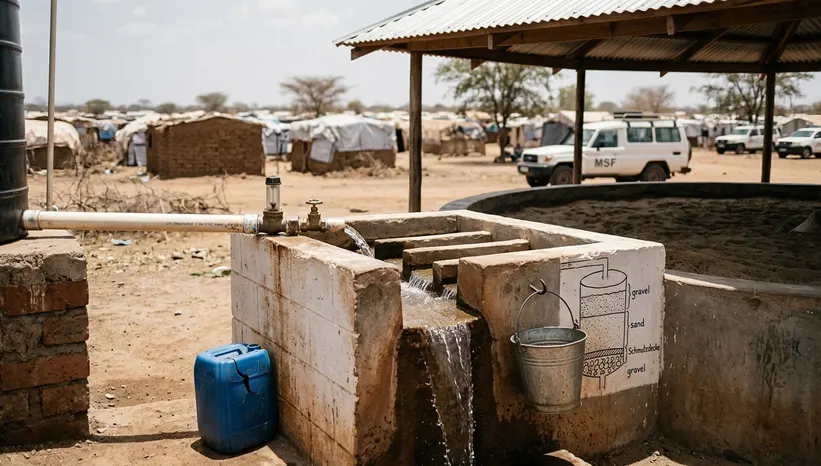
Alt text: Slow sand filter inlet and protected sand surface in a camp treatment area
Step 1: Assess the Water Source Before Building the Filter
Compare source types before choosing the treatment chain
Protected groundwater sources such as boreholes and deep wells usually start from a stronger position than open streams, rivers, and lakes. They are less exposed to direct fecal contamination, animal access, surface runoff, and sudden sediment loads after rain. That does not make them automatically safe, but it changes the treatment burden.
Heavily polluted surface water normally needs a stronger treatment chain before distribution. If a river rises after a storm and carries silt, latrine seepage, and upstream waste, a slow sand filter alone will clog quickly and may be pushed beyond its intended function. Field teams determine the need for pre-treatment by measuring raw water turbidity, then adding sedimentation basins or roughing filters when conditions exceed the operating threshold.
Raw water turbidity should generally remain below 10 to 20 Nephelometric Turbidity Units to prevent premature clogging of the biological layer. These ranges are planning references, not a substitute for source inspection and routine field testing at the actual intake.
Improve the catchment before treating the water
Spring boxes and infiltration galleries can improve raw-water quality before filtration by reducing direct contact with surface contamination. A spring box protects the emergence point. An infiltration gallery draws water through surrounding soil or gravel before collection. Neither replaces treatment, but both can reduce the load arriving at the filter.
Quick Tip: If the team is arguing over filter size before it has mapped runoff paths, animal access, nearby latrines, and turbidity behavior after rain, the design process is out of order.
Step 2: Understand the Filter Mechanism
The slow movement of water through sand is both a physical and biological treatment process. Particles strain out in the upper layers, finer material settles into pore spaces, and organisms encounter a biologically active surface that changes water quality as it passes through.
The biological skin, commonly called the schmutzdecke, is the active surface layer that helps kill or reduce pathogenic organisms. It does not appear instantly. The biological skin needs roughly two to three weeks of continuous water flow before it effectively reduces pathogenic organisms.
For camp water safety, the relevant pathogen groups include eggs, cysts, bacteria, and viruses. The filter does not act on each group in the same way. Larger eggs and some cysts are more strongly affected by physical removal, while bacteria and viruses require more attention to biological activity, contact time, and post-filtration disinfection.
A newly built slow sand filter can look finished before it is ready. Operators need to protect it during maturation, avoid aggressive cleaning, and communicate that early filtered water may still require strict downstream treatment.
Step 3: Build and Operate for Camp Conditions
Protect the sand surface
The inlet deserves more attention than it often receives. Raw water entering with force can scour the surface, break the developing biological skin, and create preferential channels through the sand. Operators establish a calm inlet zone by directing incoming water onto a splash plate or stone apron so the energy of the flow dissipates before it reaches the filter bed.
Flow should remain slow and steady to protect the biological skin. Stop-start operation, sudden surges, and rough cleaning all reduce reliability. Filter media selection also matters: the sand should have an effective grain size of 0.15 to 0.35 millimeters, with a uniformity coefficient of less than 3.
Control collection behavior
Camp operation does not end at the outlet pipe. People should not dip hands, cups, or shared ladles into treated water. Use jerrycans or buckets designed for safe collection and storage, with narrow openings where feasible and lids that actually fit after repeated use.
This is where a technically sound filter can lose its value in minutes. A child rinses a cup in a storage bucket. A collector rests a jerrycan cap on muddy soil. A queue forms at the tap stand and users start touching the outlet because the flow is slow. The remedy is not only instruction; it is layout, supervision, container design, and enough collection points to reduce pressure.
Note: Slow sand filtration is highly vulnerable to freezing temperatures. In sub-zero camp environments, the biological layer may go dormant or die unless the filter is placed in an insulated enclosure.
Step 4: Combine Filtration with Disinfection and Safe Storage
Chlorination may still be required after filtration, especially where cholera, typhoid, or other epidemic risks are present. Filtration contributes biological and mechanical reduction. Chlorination is effective against viral and bacterial pathogens when dosing, contact time, and residual monitoring are controlled.
Post-filtration chlorination also provides residual protection during transport and storage. WASH coordinators commonly adjust dosing based on daily residual testing at communal tap stands. Chlorination protocols target a free residual chlorine level of 0.2 to 0.5 milligrams per liter after a minimum contact time of 30 minutes.
Adjusting chlorination contact times based on the pH and temperature of the filtered water matters because the same dose does not behave identically in every setting. Cold water, high pH, and organic load can all complicate field control. For broader health-based framing, the WHO Guidelines for Drinking-water Quality remain the standard reference point.
Treated water quality finally depends on the container. Unsafe jerrycans, open buckets, cracked lids, and dipping practices can reintroduce fecal contamination after all upstream treatment has been completed.
Alt text: Diagram showing camp water moving from protected source through filtration, chlorination, collection, and safe storage
Step 5: Protect the Treatment Chain with Sanitation Controls
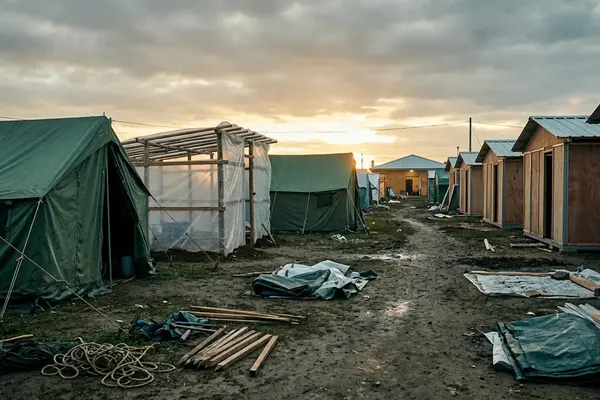
Water treatment fails when excreta, wastewater, and solid waste are poorly managed around the camp. The filter may be operating correctly while the intake is being contaminated by runoff from bathing areas, overflowing pits, animal waste, or drainage channels cut too close to the source.
Feco-oral transmission links hands, water, food, and contaminated soil. A person does not need to drink directly from a dirty stream to become exposed. Contamination can move from a latrine area to a hand, from a hand to a food container, from a container to a household storage vessel, and from there into a cup.
Camp planners map sanitation zones by calculating the hydraulic gradient of the site, placing excreta disposal and wastewater facilities downstream and at a safe elevation from water points. Emergency trench latrines and ventilated improved pit latrines must be constructed at least 30 meters away from any groundwater source or infiltration gallery.
Emergency trench latrines are temporary excreta disposal measures, not permanent sanitation infrastructure. Zigzag entrances improve privacy and help control animal entry. A VIP latrine provides a more developed option when settlement duration, soil conditions, and maintenance capacity justify it.
Cold chain work teaches a useful discipline here: one weak segment can spoil an otherwise careful system. Water safety has the same chain logic, except the weak segment may be drainage, handwashing access, or a storage bucket.
Step 6: Monitor Performance Without Overclaiming Certainty
Use daily operational checks
Monitoring reports show that the most useful field checks are often plain and repetitive: flow condition, sand-surface disturbance, source changes, container hygiene, and signs of recontamination. None is decorative. Each one points to a failure mode that can affect health.
Technicians monitor head loss daily. When the water level rises above the maximum design head because of clogging, they scrape the top layer of the biological skin. Scraping removes 1 to 2 centimeters of sand and requires a re-maturation period of 2 to 4 days before the filter can return to full operational capacity.
Premature clogging of the schmutzdecke due to sudden spikes in raw water turbidity following heavy rainfall should trigger a review upstream, not just another cleaning cycle. If the intake is pulling in storm sediment, the filter is receiving a load it was not meant to absorb continuously.
Read water tests as evidence, not decoration
Coliforms and E. coli are evidence indicators for fecal contamination. They are not lab details added to make a report look complete. Their presence should push the team to examine the whole chain: source, intake protection, filter condition, chlorination, tap stand hygiene, transport containers, and household storage.
Sudden changes in turbidity, odor, or disease reports deserve the same chain review. A narrow filter-only response may miss the actual cause.
Summary: Daily slow sand filter operation and maintenance checks should include raw-water turbidity at the inlet, the condition of the splash plate, the supernatant water level, visible sand disturbance, outlet clarity, container hygiene, and any community reports of diarrhea clusters or unusual taste and odor.
Scope, Capacity, and Limitations in Camp Planning
Slow sand filtration planning must connect treatment rate to actual demand. Historical refugee water targets from 1982 used 15 to 20 liters per person per day as a baseline for calculating total camp filtration volume requirements. That baseline helps frame the arithmetic, but camp layout, climate, cooking practice, health facilities, and queuing time can all change operational demand.
The conservative approach is to treat slow sand filtration as a stable, low-mechanization treatment process with strict conditions. It needs appropriate raw water, protected hydraulics, trained operators, and disciplined downstream handling. It also needs honest communication: a clear-looking outlet does not prove safe drinking water.
Used well, slow sand filtration gives camp WASH teams a practical treatment step that can be built around field labor and routine observation. Used loosely, it becomes a box of wet sand that gives false confidence. The difference is not the name of the technology; it is the chain of decisions around it.