Key Takeaways for Discussion Leaders
Summary: Camp living conditions should be discussed as human rights concerns, not only as supply-chain or site-planning problems. Shelter, water, sanitation, health care, food access, safety, privacy, education, and participation work as a connected system. When one part fails, dignity and access often fail with it.
A discussion leader gets better answers by starting with responsibility, exclusion, remedy, and participation. The question is not only whether a service exists. It is whether camp residents can use that service safely, fairly, and without losing privacy or agency.
Curriculum designers often structure the opening takeaways to move participants away from isolated logistical hurdles. A leaking shelter is not just a construction issue. It can affect sleep, family life, disease exposure, school attendance, document security, and the ability to keep food dry.
- Responsibility: Which authority, agency, or contracted actor can change the condition?
- Exclusion: Who cannot reach or use the service as designed?
- Remedy: What short-term correction and longer-term repair are available?
- Participation: How are residents involved before the next decision is made?
This framing keeps the discussion practical. Rights analysis should not float above the camp map; it should touch the drainage channel, the distribution queue, the clinic door, and the latrine path after dark.
Using Human Rights as the Analytical Lens
Human rights language gives camp-condition analysis a disciplined vocabulary. The right to an adequate standard of living can direct attention toward shelter, water, food, clothing, and basic domestic life. The right to health opens questions about clinics, disease prevention, medication access, referral systems, cold chain reliability, and environmental hazards. Education, family life, privacy, and security add further tests for whether a camp is merely functioning or actually livable.
The International Covenant on Economic, Social and Cultural Rights is a useful external reference because it connects living conditions, health, education, and social protection within a legal framework. It does not, by itself, tell a facilitator whether a particular drainage trench, food queue, or bathing area is adequate. That judgment needs context and evidence.
Separate law, standards, and targets
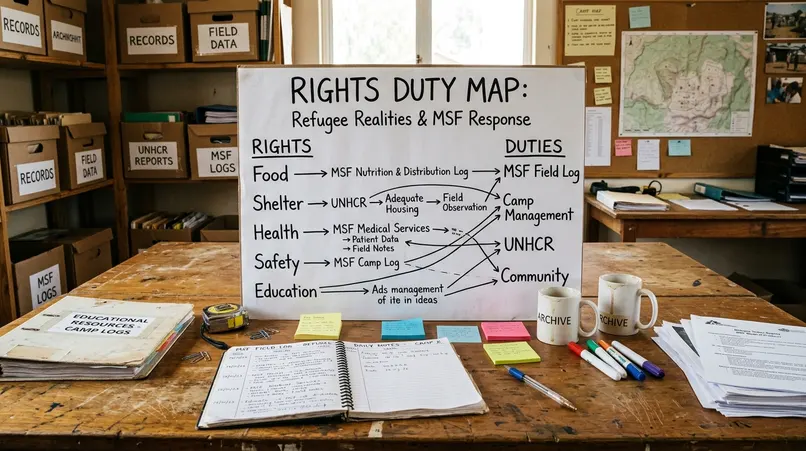
Legal rights, humanitarian standards, and operational targets are related, but they are not interchangeable. Legal rights identify obligations and protections. Humanitarian standards translate field practice into minimum expectations for assistance and protection. Operational targets are planning tools that teams use under real constraints: procurement delays, road closures, seasonal water stress, staffing gaps, or host-government restrictions.
When mapping duty bearers, field coordinators usually separate host states, camp authorities, humanitarian agencies, contractors, community structures, and armed actors where relevant. That categorization prevents a discussion from collapsing into a single blame narrative. It also makes remedies more realistic, because the actor who can authorize land use may not be the actor who maintains tap stands.
Camp Conditions That Should Anchor the Conversation
The strongest classroom or practitioner discussion begins with concrete conditions. Abstract concern becomes useful only when it is tied to what residents face in the morning, during rain, at a distribution point, or while walking to a latrine at night.
Shelter, density, and weather exposure
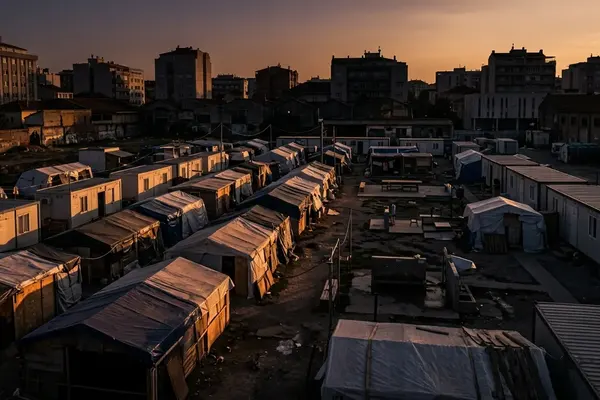
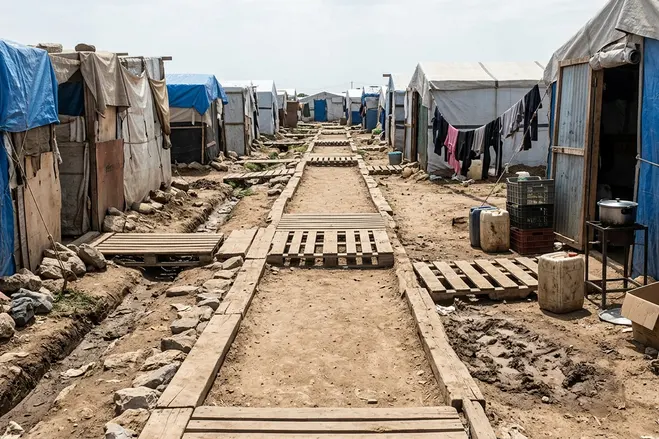
Shelter density affects more than comfort. Crowded plots can reduce privacy, increase tension between households, complicate fire safety, and leave little room for cooking, drying clothes, or separating sick family members. Weather exposure adds another layer: heat, cold, wind, standing water, and dust all change what the same shelter design means in practice.
A technically acceptable shelter can still fail residents if it sits in a flood-prone depression or if household members cannot secure documents, medicines, or school materials. The assessment question should be comparative: what does this shelter allow the household to do, and what does it prevent?
Water, sanitation, drainage, and waste
Water access is both a survival issue and a time-use issue. Distribution schedules that vary with seasonal depletion of local aquifers can reshape daily life, especially for caregivers, older people, and children sent to collect water. A queue that is manageable in the dry season may become unsafe or unworkable when paths turn to mud.
Sanitation needs the same layered reading. Assessment teams sometimes considered a strict pass/fail metric for infrastructure, but that approach misses too much. A VIP latrine built with careful dimensions may still be unusable if the route is unlit, the door does not lock, the slab cannot be used by a person with limited mobility, or the facility is too exposed for women and girls after dark.
Drainage and waste management often look secondary until they fail. Standing water near shelters, blocked channels beside markets, and waste pits close to play areas change disease risk, dignity, and household routines at the same time.
Clinics, nutrition support, and safe distribution
A clinic should not be evaluated only by its walls, shelves, and opening hours. A perfectly constructed clinic that remains empty because undocumented residents fear deportation upon entry is not accessible in the rights-based sense. The barrier is not medical equipment; it is trust, protection, and the perceived consequence of seeking care.
Nutrition support and food distribution need the same attention to use. Can residents reach the site without harassment? Are queues shaded, orderly, and understandable? Can people with disabilities, older people, separated children, or households without documentation receive assistance without public humiliation?
Quick Tip: Ask whether the condition protects dignity as well as survival. If the answer depends on the time of day, season, legal status, gender, disability, or language, the discussion has found the right level of detail.
Core Questions for Students, Practitioners, and Journalists
The same rights-based foundation can serve different audiences, but the prompts should not be identical. Students may need to distinguish legal recognition from lived access. Practitioners need triage discipline. Journalists need evidence standards that avoid exaggeration and flattening.
For students
- Which rights appear relevant when residents describe shelter, sanitation, clinic access, schooling, and safety together?
- Where does formal recognition of a right differ from lived access to that right?
- What evidence would show that a service exists but remains practically unusable?
- How should a discussion account for residents who avoid services because of fear, stigma, distance, or documentation concerns?
For humanitarian practitioners
- When several risks are present at once, which conditions require immediate protection or WASH action, and which require planned infrastructure work?
- What minimum evidence is needed before declaring a condition under-resourced, unsafe, discriminatory, or inaccessible?
- Which actor can correct the problem: site management, host authorities, WASH teams, health teams, protection staff, logistics, or community leadership?
- What resident feedback mechanism can confirm whether the correction worked?
For journalists and public educators
- Is the description precise enough for readers to understand the condition without spectacle?
- Does the account distinguish camp residents, authorities, agencies, donors, contractors, and armed actors where relevant?
- Has the reporting avoided treating one visible hardship as proof of every institutional failure?
- What remedy or accountability question follows from the observation?
Facilitators group prompts by audience because each group tends to overreach in a different direction. Students may jump too quickly to legal conclusions. Practitioners may narrow the problem to what their sector can fund. Journalists may select the most visible image and miss the system behind it.
Facilitating Without Turning Suffering Into a Classroom Exercise
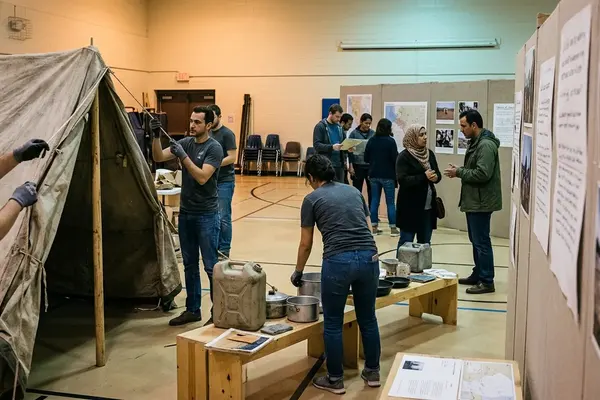
Refugee camp conditions should not be used as shock material. The point is not to make participants imagine trauma theatrically; the point is to examine rights, choices, constraints, and accountability with care.
Educators who use anonymized case materials often strip out sensational details before discussion. That choice does not soften the issue. It keeps attention on agency, decision-making, and the conditions that can be changed.
Language choices matter
Use people-first terms. Say “camp residents,” “refugees,” “asylum seekers,” or “displaced people” when those terms fit the context. Avoid portraying people as passive recipients of aid. Residents organize water collection, care for relatives, negotiate safety, share information, challenge decisions, and adapt shelter space with whatever materials are available.
Precision also protects analysis. A host-government rule is not the same as an agency procedure. A camp authority is not the same as an armed actor. A distribution volunteer is not the same as a donor. Blurring these roles may sound compassionate, but it weakens accountability.
Note: Avoid asking participants to “imagine being a refugee” as a shortcut to empathy. Ask them to identify the decision points, constraints, affected groups, and remedies instead.
A Practical Case-Analysis Method for Camp Living Conditions
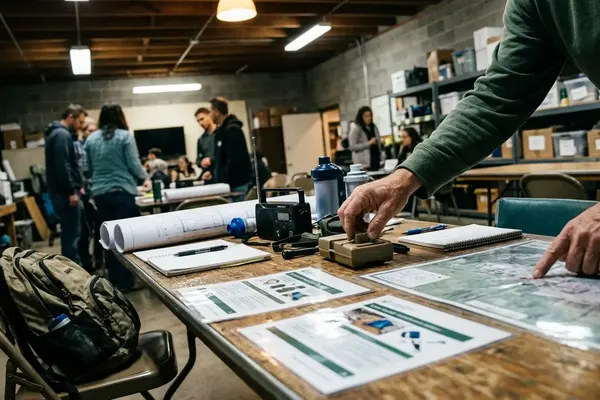
This exercise uses a hypothetical assessment scenario. It does not invent a real camp, a real incident, or a numerical finding. The method is sequenced so participants establish neutral, observable facts before drawing conclusions about rights concerns.
Step 1: Describe observed conditions
- Write only what an assessor could observe or verify: location, condition, access route, time of day, user groups, visible hazards, and service availability.
- Avoid legal conclusions in the first note. Do not write “the camp violates privacy.” Write “the bathing area has torn screening, no working latch, and a direct sightline from the main path.”
- Record variation. A water point may function in the morning and fail in the afternoon. A path may be passable in dry weather and dangerous after rain.
This first step is slow by design. It prevents the discussion from becoming a contest of assumptions.
Step 2: Identify rights and humanitarian concerns
- Link each condition to possible rights concerns: health, adequate living conditions, privacy, education, security, family life, or participation.
- Identify humanitarian concerns in sector terms: WASH, shelter, protection, health, nutrition, site planning, logistics, or education.
- Separate immediate action from planned improvement. A broken sanitation route that creates urgent safety or disease concerns belongs in a short action window; drainage redesign or durable latrine replacement may require a medium-term works plan.
Step 3: Map responsibility and remedy
- Name the actor with authority to approve the change.
- Name the actor with capacity to implement the change.
- Name the resident group most affected by the condition.
- Define how residents will be consulted before the remedy is finalized.
Program evaluation revealed a recurring lesson in similar teaching exercises: the remedy often changes once participants ask who cannot use the service. A repair that looks technical at first may become a protection, disability-access, or information problem after consultation.
Scope, Limits, and What This Guide Cannot Prove
This guide draws on human rights law, humanitarian standards, field practice, and educational application. That breadth is useful, but it has limits.
It is not a legal determination of violations in any specific camp. It does not replace legal analysis, protection monitoring, public health assessment, engineering review, or resident-led consultation. Conditions vary by country, conflict history, host-government policy, funding level, climate, camp age, land tenure, and access constraints.
One catch is especially important: the framework assumes a baseline level of humanitarian access to the camp. In active conflict zones, closed detention-style facilities, or areas with severe movement restrictions, the evidence base may be partial and the remedy options sharply constrained.
That said, treat this as a structured discussion method, not a finding that a particular camp has met or breached a legal threshold.
What a Rights-Based Discussion Should Leave Behind
A strong discussion leaves participants with a double view. Refugee camp conditions are operational realities and rights questions at the same time.
The operational view asks whether shelter, water, sanitation, clinics, nutrition support, lighting, drainage, education space, and distribution systems exist and function. The rights view asks whether people can use those systems with dignity, safety, access, participation, and accountability.
The distinction matters in the field. A service can be present but unusable. A clinic can be built but feared. A latrine can be technically sound but unsafe. A water schedule can exist but exclude households that cannot wait in line at the assigned time.
The best teaching note is concise: do not ask only whether aid exists. Ask whether people can use it safely, fairly, and with meaningful voice.