Key Takeaways for Exhibit Designers and Educators
Poor exhibit design leaves visitors with emotional impressions but little ability to understand humanitarian decisions, constraints, or consequences. Curators determined the educational framework for recent installations by analyzing post-visit comprehension, shifting the focus from emotional resonance to the visitor's ability to map basic logistical dependencies. Refugee camp education is strongest when visitors examine how shelter, water, sanitation, health, supply, and protection systems interact.
Core Principles for Exhibit Design
- Teach decision systems: Focus on the logistics and constraints that shape humanitarian response.
- Avoid claims of experiential equivalence: Do not suggest a museum visit can replicate displacement.
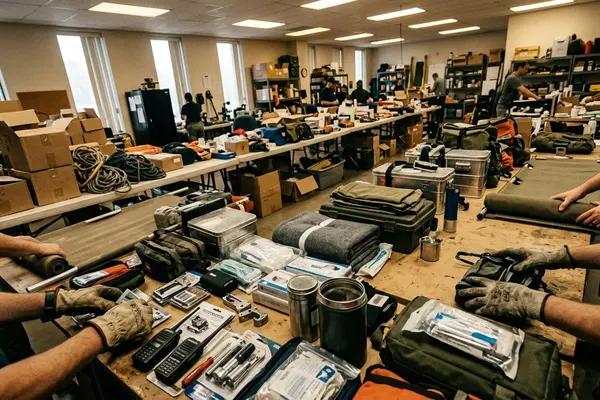
- Connect objects to operational choices: Show the supply chain behind every artifact.
- Evaluate explanation ability: Measure what visitors can articulate about trade-offs after the exhibit.
Why Simulated Suffering Produces Weak Understanding
Compressed tents, darkness, deprivation exercises, and forced role-play imply that a short museum encounter can reproduce displacement. During a multi-year planning phase, the design committee explicitly rejected the approach of using compressed, darkened spaces and forced role-play. Simulating trauma centers the visitor's temporary discomfort. It turns displaced people into a condition for visitors to perform, ignoring the people making decisions within political, legal, social, and material constraints.
Intense sensory cues dominate attention and obscure the mechanics of the response. Audio tracks playing crowd noise at roughly 85 to 90 decibels overwhelm the educational narrative. This creates a documented failure case: visitors remembering the sound of simulated gunfire but unable to explain why food distribution was delayed. The sensory experience masks who controls access, why supplies are delayed, how priorities are set, and which risks remain unresolved.
Make the Humanitarian System the Subject of Inquiry
Systems teaching involves tracing relationships among needs assessment, authority, funding, procurement, transport, site planning, staffing, maintenance, communication, and accountability. Exhibit developers mapped the lifecycle of a standard collapsible jerrycan, tracing its journey from regional procurement hubs to local distribution, to illustrate the hidden administrative layers of emergency response.
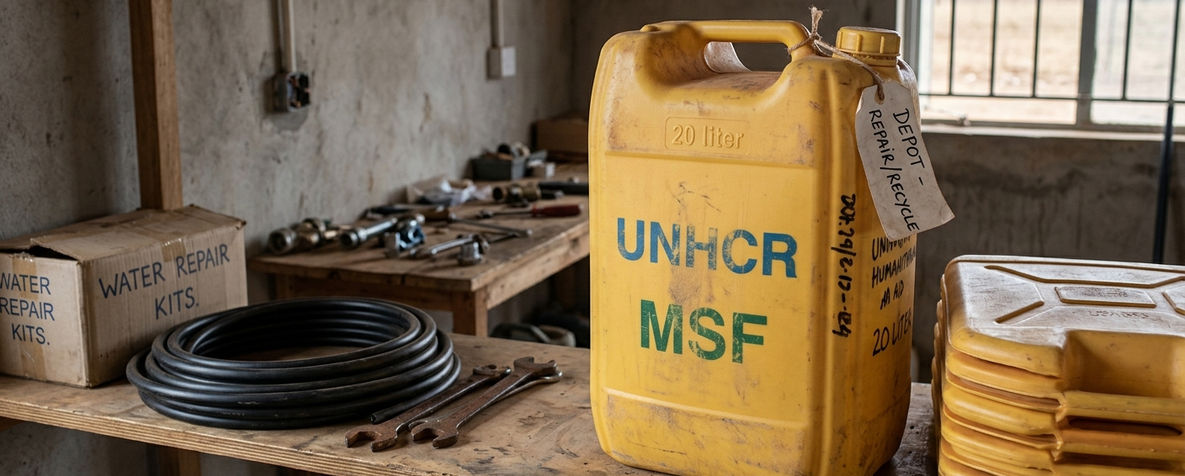
Interpretation requires consequential questions. Who decides? What information is available? What is constrained? Who may be excluded? What happens after the initial intervention? A jerrycan, shelter component, registration document, or medical supply becomes educational when its placement within a decision chain is made visible. Procurement lead times of about two to three weeks for bulk sanitation supplies dictate the pace of the response, turning a static object into a lesson on real supply chain limitations.
A Decision Trail: What Happens When a Water Point Fails?
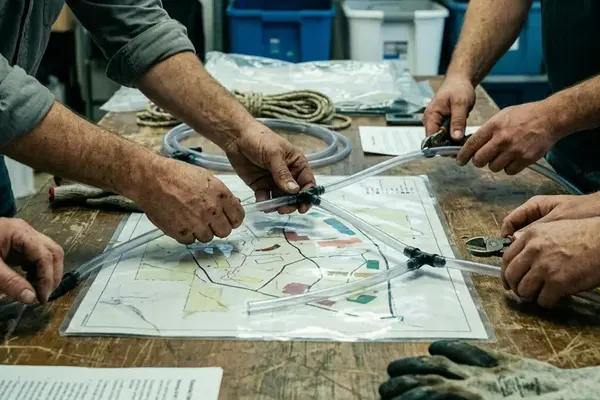
A bounded exhibit scenario demonstrates this method effectively. Consider a water point that stops operating during a period of high demand. The scenario was constructed by reverse-engineering a documented field incident where a submersible pump failure forced logisticians to choose between trucking water or rationing existing storage.
Visitors trace dependencies involving storage, pumps, pipe fittings, water-quality checks, repair capacity, replacement parts, transport access, staffing, and communication. They must balance emergency water standards of 15 to 20 liters per person per day against repair timelines spanning 48 to 72 hours for specialized pump components. A technically plausible response may still create protection concerns if alternative collection points require longer travel, unsafe routes, or extended queues.
Accounting for Demographic Shifts
One catch: this tabletop model assumes a static population size, whereas real camp demographics fluctuate daily due to new arrivals and departures, altering demand calculations. Planners must also account for context-dependent variation, such as adapting water distribution strategies in arid environments versus flood-prone transit centers.
Teach Protection and Public Health as Interdependent
Site layout, lighting, drainage, shelter density, queue design, mobility access, sanitation placement, and information channels affect both health and protection. Designers paired physical models of VIP latrine blocks with lighting schematics to visually demonstrate how infrastructure placement directly dictates the physical safety of vulnerable groups at night.
Paired comparisons reveal operational trade-offs. Centralizing a service simplifies supply and maintenance. Distributing that same service reduces travel burdens but increases staffing demands. Meeting the standard maximum distance of around 50 meters from a shelter to the nearest communal latrine requires balancing these competing priorities.
Aggregate service provision conceals unequal access. A certified camp layout might look efficient on paper while creating barriers for children, older people, people with disabilities, caregivers, and people facing discrimination or security threats.
How to Build a Systems-Based Humanitarian Exhibit
Begin with two or three explicit learning outcomes focused on explanation. Ask visitors to identify dependencies or compare the consequences of competing response choices. Select a bounded operational question rather than attempting to recreate an entire refugee camp or a universal refugee experience.
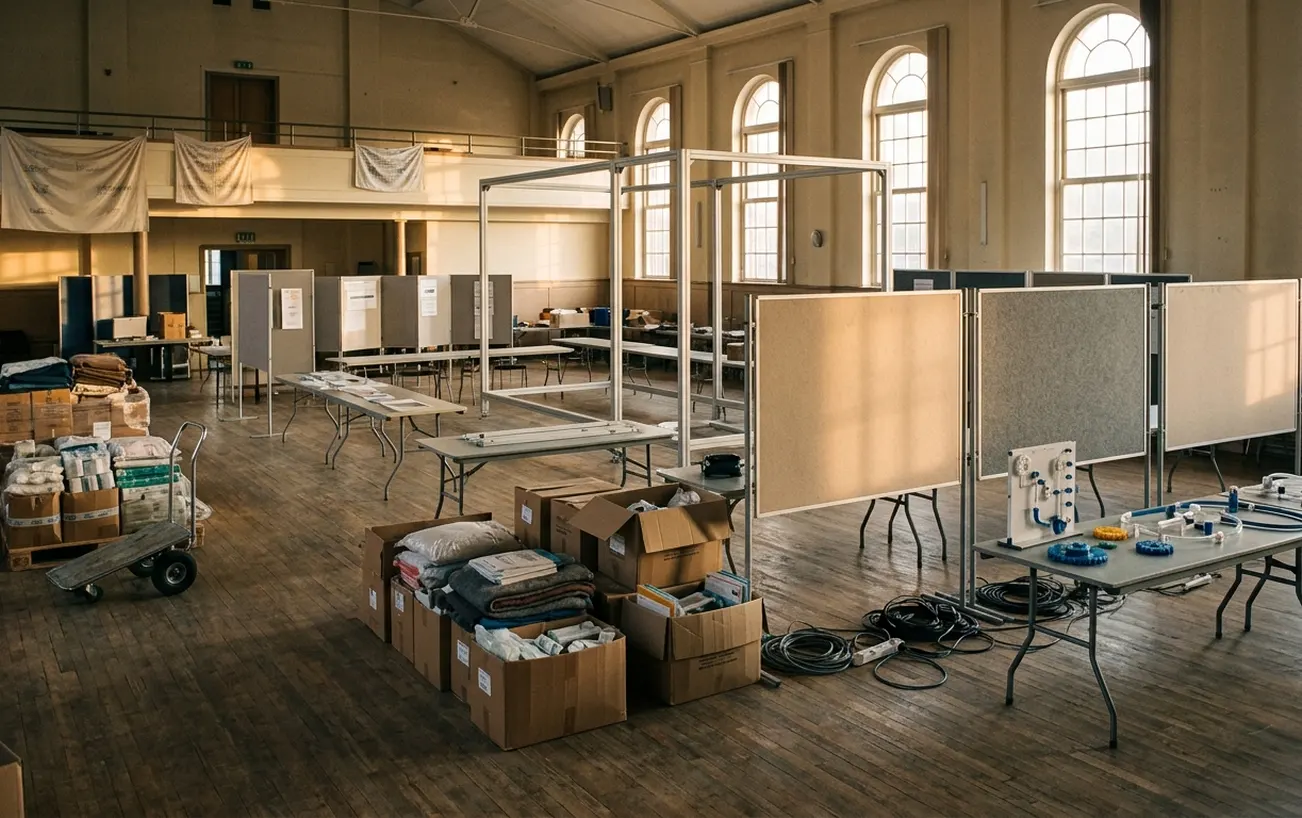
The team structured the physical space into three distinct interpretive layers, allowing general admission visitors to grasp basic trade-offs while providing practitioners with detailed technical dossiers. This layered approach builds interpretation from a concise overview for general visitors to a decision sequence for students, ending with deeper technical context for practitioners or educators.
An Editorial Standard for Dignified Learning
Evaluate whether visitors can explain a decision chain, identify a trade-off, distinguish a standard from a local reality, and recognize whose perspective is missing. While tabletop models isolate specific variables for clarity, assessors shifted evaluation rubrics from measuring emotional impact via exit surveys to using facilitated observation, tracking whether visitors could accurately articulate the trade-offs presented in the exhibit.
Check labels for unsupported universals, unclear scenario assumptions, decontextualized testimony, and language that reduces displaced people to passive recipients. Maintain accuracy through operational content review cycles scheduled every 18 to 24 months to align with updated humanitarian standards.
Exhibit designers must abandon the illusion of experiential empathy and commit entirely to structural transparency—build exhibits that force visitors to grapple with the cold chain logistics, procurement delays, and site planning compromises that actually determine survival.