How Does Household Waste Reach Safe Disposal in a Refugee Camp?
How does household waste reach safe disposal in a refugee camp? Safe disposal happens only when containment, dependable collection, a suitable receiving site, and separate handling of hazardous waste function as one connected service. Curators designing educational camp exhibits often evaluate displaying a single galvanized waste drum to represent sanitation, yet field logisticians advise mapping the full transport chain instead so visitors understand that a container without an emptying schedule and approved receiving site simply concentrates refuse.
Bins alone cannot deliver safe waste management. Responsibility must remain clear through household containment, block collection, perimeter transfer, and final disposal.
The eight operational components below are organized by their sequential place in the service chain from shelter generation to final disposal, rather than ranked by importance. Field teams assess each node through five operational criteria: containment, accessibility, worker protection, environmental suitability, and continuity of service. When planners examine the service chain through four operational checks—bin perimeter soil state, handcart aisle clearance, transfer apron residence time, and signed receiving-site gate receipts—they expose where a camp waste system actually succeeds or breaks down.
1. Identify Waste Streams Before Choosing Containers
Before ordering storage drums or handcarts, camp WASH coordinators audit incoming relief supply packaging and local market stalls to classify refuse into four primary solid waste streams: household refuse, market waste, bulky materials, and healthcare waste. Wastewater and excreta require separate sanitation systems—such as a VIP latrine network or lined drainage channels—though poor coordination between solid waste and excreta management quickly compounds environmental hazards when plastic bags block drainage ditches or fill latrine pits.
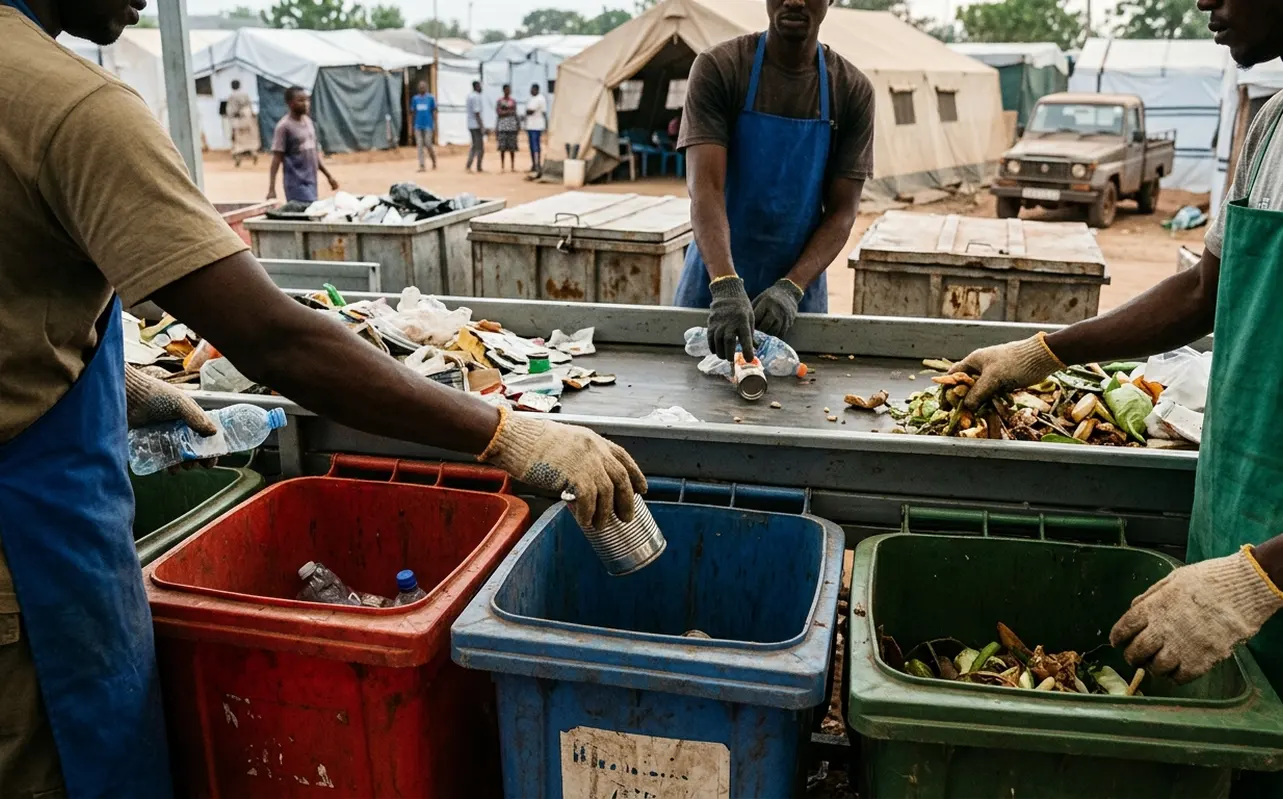
Different materials place distinct demands on collection equipment and handling crews. Food waste carries high moisture and attracts flies rapidly; dry packaging adds volume without heavy weight; broken jerrycans and discarded household items create sharp edges or bulky loads that jam small carts. Supply-chain audits indicate that dry ration distributions versus fresh market produce alter organic moisture density within 3 to 5 days of arrival.
Waste composition shifts alongside food distribution cycles, local market vibrancy, settlement layout, and available camp services. A reception transit site distributing pre-packaged biscuits generates a completely different refuse profile than an established settlement with active butcher stalls and carpentry workshops, making any single camp waste profile invalid as a universal template.
2. Make Household Storage Contained and Accessible
Durable, cleanable containers fitted with tight covers keep refuse contained at the shelter level, limit scavenging by animals and insects, and stop wind from scattering light plastics across living areas. WASH teams establish container distribution protocols only after assigning specific maintenance rosters for washing, lid repair, and replacement, preventing the rapid deterioration of unowned communal bins. Depending on shelter density, coordinators select 15-to-50-liter lidded high-density polyethylene buckets for household-level storage or 100-to-200-liter drums for shared shelter clusters.
Protect Shelter Walkways
Place shared cluster drums where residents can reach them easily without blocking emergency access lanes, encroaching on family shelters, or contaminating water tapstands and communal latrines. Supervisors routinely inspect a 2-to-3-meter perimeter around each bin for leachate staining and scattered wrappers to verify that the container size matches daily generation.
Physical placement requires careful ground observation rather than fixed universal distance rules. Steep slopes, drainage gullies, and night lighting determine whether a resident will actually walk to a communal drum after dark.
Accessibility also depends on physical mobility. Older residents, people with disabilities, and child-headed households often cannot carry heavy buckets to shared collection points. Effective block plans pair communal drums with targeted doorstep collection or designated neighbor-support arrangements so vulnerable households are never left with accumulating refuse inside their shelters.
3. Match Collection Routes to Camp Access and Worker Safety
Planners walk every shelter aisle during both dry and wet conditions to select collection equipment; relying solely on heavy compactor trucks was rejected in dense camp sectors because narrow footpaths and uncompacted soil trap heavy axles and damage shallow water pipes. Matching the vehicle to the terrain keeps the service chain moving from the shelter cluster to the camp perimeter.
- Handcarts and wheelbarrows: Require approximately 1.2-to-1.5-meter clear pathway widths. They navigate tight shelter rows well and require minimal mechanical maintenance, but demand high physical effort from crews and must tip into a nearby transfer point.
- Motorized three-wheelers and tipping tractors: Require corridor widths in the range of 2.5 to 3.5 meters. They bridge medium haul distances between residential blocks and perimeter stations, though they require fuel supply lines and routine mechanical servicing.
- Heavy haulage trucks: Operate strictly on reinforced main camp roads and perimeter tracks to move bulk loads from transfer stations to final disposal sites.
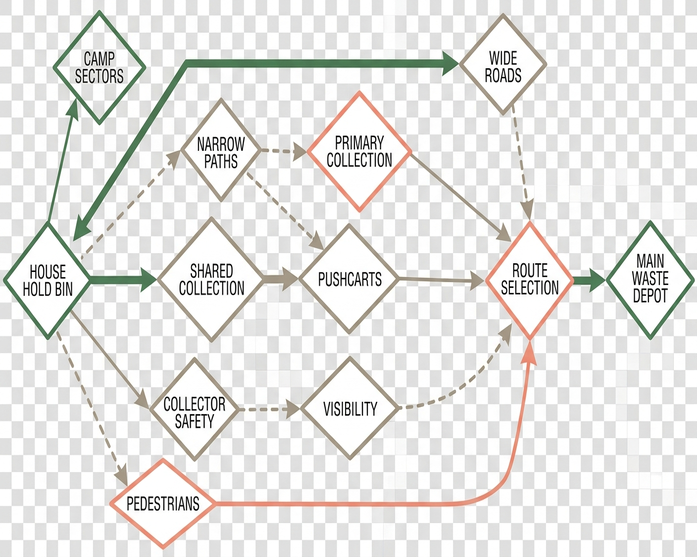
Collection timing responds to observed bin accumulation, the proportion of putrescible food waste, seasonal rainfall, and vehicle availability rather than a rigid calendar template. High organic loads in warm weather require frequent emptying to interrupt fly breeding.
Every collection sector operates under a designated service lead with clearly assigned crew routes. Worker protection is built into daily dispatch: crews wear heavy-duty puncture-resistant gloves, steel-toe boots, and high-visibility vests, follow safe lifting practices when tipping 200-liter drums, wash down carts at the end of the circuit, and use soap-equipped handwashing stations at shift end.
4. Keep Transfer Points from Becoming Open Dumps
A transfer point is a managed logistical handover between primary block collection and secondary bulk transport. Site planners position transfer stations at the perimeter of residential blocks where handcart crews can tip loads directly into roll-off skips or trailer beds without bogging down haulage trucks inside living quarters.
To prevent a transfer point from degrading into an uncontrolled neighborhood dump, the facility requires a hard-standing concrete or compacted gravel apron with perimeter drainage bunds and fencing. Fencing controls vehicle access and keeps children and livestock away from tipping bays. Crews sweep spilled refuse immediately after loading, clear drainage channels to prevent contaminated runoff, and operate against a confirmed onward truck schedule. In warm climates, operators enforce a maximum holding window of 24 to 48 hours to prevent fly breeding cycles. If muddy access roads or mechanical breakdowns delay the haulage truck beyond that window, temporary storage rapidly turns into persistent accumulation that overwhelms the block.
5. Select Final Disposal Around Ground Conditions and Oversight
An authorized, managed disposal facility differs fundamentally from an open dump through strict perimeter fencing, a manned entry gate to log incoming loads and exclude scavengers and livestock, operational supervision, and daily soil cover layers applied at shift conclusion to suppress vectors and windblown litter. Environmental health officers evaluate hydrogeological data, seasonal flood lines, and host-authority permits before authorizing any disposal method, ensuring emergency burial is never treated as a permanent engineered landfill.
Controlled on-site burial pits can serve acute emergency phases, yet field assessments under regional host-authority environmental frameworks show that site physical limits frequently rule out excavation. Specifically, on-site burial pits become unviable where high water tables, fractured bedrock, seasonal flooding, or tight camp boundaries create groundwater contamination hazards. For example, where a high water table rules out burial, crews transfer collected waste into haulage trucks at the camp perimeter for transport to an authorized engineered municipal facility; receiving-site gate receipts document delivery.
6. Recover Materials Only Where Safe Outlets Exist
Material recovery reduces the volume bound for final disposal only when four conditions align: reasonably clean separated streams, safe intermediate storage, dedicated collection transport, and an active off-site processor or local market willing to take the material. Coordinators assess off-site processor demand and safe baling space before asking residents or workers to separate plastics, metals, or organics, avoiding the accumulation of unsellable material piles.
Separating recyclables without a confirmed buyer creates fire hazards and vector harborage inside the camp. Where verified outlets or agricultural programs exist, facilities use dedicated dry sorting bays with roof cover and washable floors for recyclables, while organic fractions undergo an estimated 60-to-90-day aerobic composting maturation window requiring active turning and moisture monitoring. Throughout any sorting or composting operation, site managers prioritize worker dignity and physical protection, eliminating manual picking from mixed hazardous piles and enforcing strict hygiene and protective gear standards.
7. Separate Healthcare Waste at Its Point of Generation
Health posts and vaccination clinics—where staff already maintain strict cold chain equipment for vaccines—must apply equal rigor to clinical waste streams. Facility protocols divide medical refuse into four clinical categories: sharps, infectious non-sharps, pharmaceutical or chemical waste, and general non-hazardous clinic refuse. Clinical staff segregate infectious items and sharps at the bedside or consultation table into dedicated puncture-proof boxes and lined receptacles, locking them in restricted holding rooms until trained technicians transfer them to high-temperature treatment units.
Segregate Clinical Sharps Immediately
Draw a hard operational boundary between clinical sharps boxes retired at the three-quarters fill line (75% capacity line) and municipal shelter refuse streams, never permitting manual sorting of mixed bags.
Once sealed at the 75% capacity line, sharps containers move through a locked storage room to a designated incinerator or burial pit inside a fenced clinical waste zone. Container labels, bag colors, and handling logs must strictly follow the applicable national health ministry or lead medical agency protocol operating in that camp rather than an improvised color scheme.
8. Verify Service Continuity and Fix Breakdowns Quickly
A waste system looks complete on a site map long before it works reliably on the ground. Supervisors cross-reference route departure logs against gate receipts at the final disposal site while conducting foot patrols to verify that emptied bins actually reached the authorized receiving facility. If ten handcart loads leave Sector B in the morning, the transfer station and final disposal logs must account for that exact volume by shift end.

Routine monitoring relies on direct physical inspection: checking for overflowing cluster drums, missed shelter lanes, spilled refuse around transfer skips, blocked drainage aprons, and unauthorized dumping along camp perimeters. Supervisors also conduct direct household interviews targeting mobility-impaired residents unable to reach shared cluster drums, ensuring their doorstep pickup arrangements remain active.
When a failure surfaces, the team records the breakdown in a four-column verification log tracking the reported issue, assigned lead, corrective action, and a mandatory 24-to-72-hour follow-up inspection. Clear ownership prevents minor cart breakdowns or overflowing skips from cascading into camp-wide sanitation failures.
How to Reroute Camp Waste Collection During Heavy Rain
When heavy rain renders a primary shelter lane impassable to handcarts, the service lead halts standard routing, designates an elevated hard-standing perimeter point for temporary collection, deploys porters to assist mobility-impaired households, and verifies onward truck pickup. Field teams can copy this five-step operational chain directly when wet weather or road blockages disrupt normal block collection:
- Receiving site confirmation: Before moving any household waste, the service lead contacts the perimeter transfer station and final disposal gate to confirm that the haulage truck can traverse the main road and the receiving bay has capacity to accept the block's load within the 24-to-48-hour holding window.
- Resident storage briefing: Community mobilizers walk the affected shelter cluster to inform families that handcart crews cannot enter the flooded approximately 1.2-meter lane, instructing residents to keep 15-to-50-liter household bucket lids tightly sealed until the temporary pickup window opens at the block edge.
- Crew collection and porter deployment: Equipped with puncture-resistant gloves, steel-toe boots, and high-visibility vests, two crew members position 200-liter lidded drums on an elevated gravel pad at the dry perimeter road, while a dedicated two-person porter team conducts doorstep collection for mobility-impaired households so no refuse is abandoned in flooded alleys.
- Transfer handover: Handcart teams ferry the filled perimeter drums along the drained 3-meter main corridor to the fenced transfer apron, tip the refuse directly into the waiting roll-off skip, sweep the concrete apron clean, clear the perimeter drainage bunds, and wash their tools and hands at the shift-end soap station.
- Destination receipt logging and follow-up: The supervisor matches the transfer skip departure ticket against the signed entry log at the fenced disposal facility, records the temporary routing in the four-column verification log, and completes a post-rain verification walk within 12 to 24 hours of route restoration to inspect the 2-to-3-meter perimeter around every cluster bin for residual litter or leachate staining.