What Makes Hygiene Promotion Work in a Refugee Camp?
How can residents follow a hygiene instruction when the water point is dry or the latrine offers no privacy? People need usable facilities and supplies, trustworthy information, and a say in how services are designed.
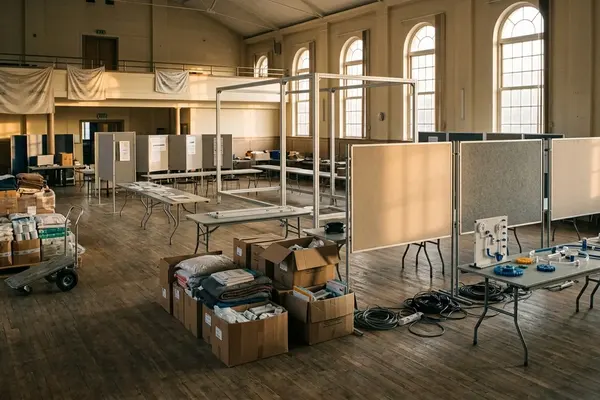
That connection shapes this exhibit. Its opening gallery puts behavioral advice beside the infrastructure that makes the advice possible. Visitors encounter handwashing, safe water storage, menstrual hygiene, and disease prevention as linked decisions about supplies, upkeep, space, and access to care. A reconstructed station can make those decisions visible. It cannot serve as evidence of what happened in a particular camp.
Keep one question in view: what would a resident need in order to follow this message today? For handwashing, that may mean water, soap, and a working tap. For safe storage, it means a suitable container and a dependable source. Menstrual hygiene calls for privacy, appropriate materials, and disposal or washing arrangements. Disease-prevention advice must connect people to a service they can reach. Each practice begins with a person, but its feasibility reaches well beyond individual choice.
A Handwashing Message Needs Water, Soap, and a Usable Station
The displayed station uses a plastic bucket with a push-tap. Exhibit designers chose this kind of field equipment over the pristine ceramic basin they first considered. The bucket brings procurement and maintenance into the visitor’s view: someone must fill it, keep the tap working, replace the soap, and deal with the water that runs onto the ground.
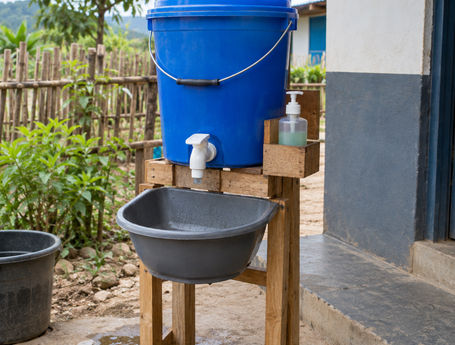
Start with its position. If the station is meant to support handwashing after use of a VIP latrine, can people find and reach it on their way out? Is the tap usable by someone who has difficulty gripping it or standing close to the bucket? Then look below the outlet. Drainage needs inspection as well as installation. A soak-pit beneath a station can fail to keep up with use, leaving wet ground where visitors might otherwise see only a tidy handwashing point.
Queues change the calculation. A station can carry the right message and still be difficult to use if residents must wait for water, walk far from their shelters, or arrive after supplies run out. A sign cannot shorten that trip. It cannot refill the bucket, either.
Health promotion and station maintenance are distinct jobs that meet at the tap. Promoters explain when and how to wash hands in language people understand; supply and maintenance teams keep water, soap, access, and drainage in place. Both jobs matter on the same day.
Check Beneath the Tap
When assessing a handwashing display, follow the used water. A working push-tap is only part of a usable station if the ground around it stays safe to approach.
Safe Water Storage Starts Before a Container Reaches a Shelter
Follow a container from the distribution point rather than beginning the story at the shelter. A resident collects water, carries it home, stores it, and pours or dispenses it for drinking. At each handoff, the opening may be exposed or a cup may touch the water. Mapping that route helps identify where equipment or handling advice could protect the supply. It is a practical observation, not an invitation to blame the person carrying the container.
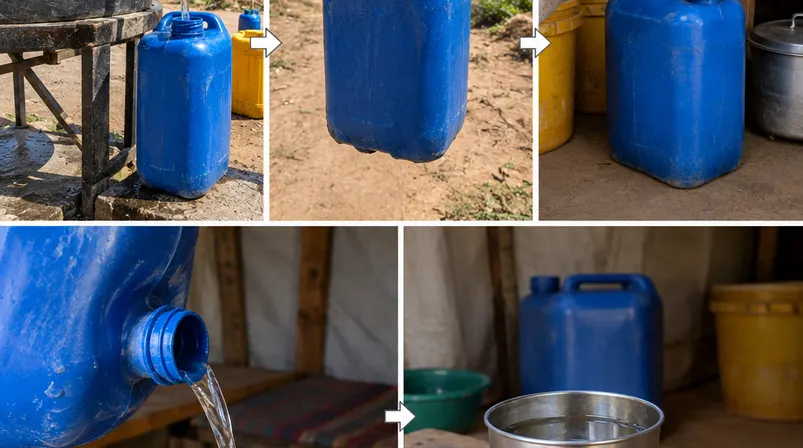
A lidded, narrow-necked container makes a useful exhibit object because visitors can see how it limits contact with stored water. Pair it with a clean way to dispense water. Then ask the less photogenic questions: Can residents obtain that container? Can they keep its lid and outlet clean? Does water arrive reliably enough for the storage advice to remain useful? A container on a plinth cannot answer those questions by itself.
Field logisticians examine the water chain by walking from a distribution point to shelters and watching how containers travel and get used. For an exhibit, that method suggests a simple design check. Before writing instructions for a particular vessel, ask residents what they actually carry. A household using a wide-mouthed bucket needs guidance suited to that bucket; an illustration of a narrow-necked jerrycan will not change the vessel in their hands.
Ask About the Vessel
Build storage advice around the containers people have access to, then check whether lids and dispensing methods can be maintained through daily use.
Menstrual Hygiene Requires Privacy, Supplies, and Disposal Options
A hygiene kit can look complete in a display case while leaving a central question unanswered: where will someone change, wash, dry, or dispose of its contents? Privacy, lighting, washing space, suitable supplies, and disposal arrangements determine whether guidance works outside the gallery.
Consider a temporary transit center where residents have no private drying lines and too little daily water for washing reusable cloth pads. Displaying those pads without the surrounding conditions would make the proposed solution appear easier than it is. The exhibit should place the material beside the space and resources it requires. That pairing lets visitors evaluate the provision rather than assume a kit list settles the issue.
Preferences also differ among people living in the same community. Consultation groups separated by age and marital status are one way facilitators make room for residents to discuss disposal and privacy concerns more openly. Those discussions should inform the choice of materials and the placement of facilities; they should not be used to assign one menstrual practice to an entire group.
Before presenting a proposed facility as adequate, ask affected people whether they can reach it, use it privately, and manage the materials afterward. Lighting may help someone get to a washing space, while a disposal point answers a different need. A sound exhibit lets visitors see those needs separately rather than treating “supplies provided” as the end of the inquiry.
Disease-Prevention Messages Must Respond to What Residents Report
An outbreak message may be clear to the person who drafted it and confusing to the person expected to act on it. Health promoters can listen to questions gathered by community health workers, identify medical terms people have misunderstood, and revise the wording. They then check whether the revised message conveys the intended action. That cycle continues as concerns and conditions change.
Picture a display that asks residents to report symptoms promptly. The visitor should be able to ask where that report goes. Can someone reach the health service? Do they know when it is available and what will happen when they arrive? Symptom-reporting advice depends on those practical details. Repeating the instruction more loudly does not create a route to care.
Here the exhibit must be precise about its own evidence. A model script and a feedback exercise can illustrate how responsive communication works. Unless records from a named camp or organization are presented, the display should describe the exercise as illustrative. That distinction protects an important lesson: listening and revision are practices visitors can evaluate without mistaking a reconstructed response for a documented event.
There is also a useful operational question beneath the wording: who can change the message when residents identify a problem? A feedback route has little effect if the people hearing concerns have no way to get a correction into circulation. Show the conversation between residents, community health workers, and promoters, then show the updated instruction. Visitors can see why disease prevention requires a service that responds as well as a message that travels.
What Visitors Should Ask of Every Hygiene Message
The final display works best as an access test rather than a quiz on hygiene rules. Give visitors a proposed message and let them examine the camp conditions around it. A request to wash hands raises questions about the station. Advice to cover stored water raises questions about containers and supply. Menstrual hygiene guidance raises questions about privacy and materials; symptom reporting raises questions about access to care.
Three questions keep the test compact:
- What practice does the message ask someone to follow?
- What water, supplies, space, or service does that practice require?
- Who has checked whether those conditions are available and usable?
Those questions shift attention toward the design and upkeep of a response. If the station is empty, visitors look for a refill plan. If a proposed reusable material needs private drying space, they look for that space. If residents say a medical term is unclear, they look for a way to revise the message. The resident remains an active participant in each example, with knowledge that can improve the service.
Make Access Visible
For every instruction in the exhibit, show the facility, supply, or service that allows someone to follow it.
Make every hygiene message answer the access question before asking people to change a practice.