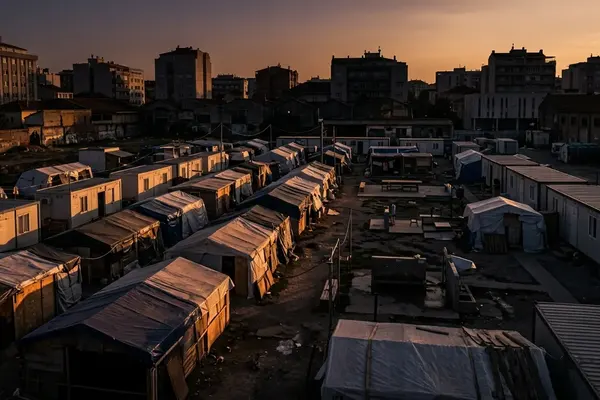
Key Takeaways: What Benaco Shows About Rapid Camp Formation
Logisticians bypassed standard phased site development. They deployed immediate survival interventions because the sheer volume of the influx outpaced any possibility of proactive land surveys or grid planning.
The central case finding stands clear: Benaco formed at extreme speed because displacement followed mass violence, border flight, and spontaneous settlement rather than planned site development. April 28, 1994 marked the start of a 200,000-person border crossing into the Benaco mountain and lake area.
Case Context: Rwanda’s 1994 Violence and the Benaco Crossing
Rwanda operated under Juvenal Habyarimana’s single-party dictatorship. The Hutu majority and Tutsi minority lived under that structure while the RPF offensive began in 1990. April 1994 brought the period of genocide and massacres against Tutsi and moderate Hutu. Benaco served as a mountain and lake site for spontaneous settlement after flight from Rwanda into Tanzania.
Challenge: A Camp Appearing Faster Than Systems Could Be Built
Site planners initially considered mapping out standard grid-based family plots. They rejected this approach entirely when they realized arriving populations were already spontaneously settling according to existing social ties and paths of least resistance. The Benaco site proved difficult because of spontaneous settlement, a very large arriving population, incomplete demographic information, and urgent need to identify vulnerable groups.
First-order service gaps appeared immediately in water storage, sanitation, food distribution, medical triage, and basic protection.
Solution: Why Responders Prioritized Water, Triage, and Distribution First
Emergency teams sequenced water access and centralized feeding stations ahead of durable shelter construction. They calculated that queue management and dehydration posed more immediate mortality risks than incomplete housing. Emergency teams typically prioritize water access before more durable camp design because dehydration, crowding, and queue management can become immediate risks.
Flexible water bladders in the 10,000-liter to 30,000-liter range supported fast storage and distribution-point setup. Targeting water point access within a 500-meter walking radius guided placement decisions.
Results: Early Stabilization, Persistent Needs, and Secondary Economies
The May 1994 evaluation came immediately after the April 28 crossing. Later observations describe Benaco six months after camp creation. Protection coordinators had to adjust their perimeter security strategies after observing that the informal firewood trade was forcing women to leave the camp boundaries, exposing them to banditry. The camp response had to absorb a 200,000-person border crossing.
Six months of observation from May to November 1994 revealed morbidity patterns shifting from acute dehydration and exposure in the first two weeks to chronic conditions and secondary economic risks.
Comparative Lessons: Benaco Beside Dadaab, Kukes, and Karen Camps
Infrastructure Triage: Planned vs. Rapid Spontaneous Formation| Operational Domain | Planned Settlement Approach | Rapid Spontaneous Approach (Benaco Model) |
|---|---|---|
| Water Supply | Borehole drilling and piped tap stands | Surface water treatment and flexible bladders |
| Sanitation | VIP latrine blocks on surveyed grids | Immediate trench latrines near spontaneous clusters |
| Food | Central warehouse with scheduled distributions | Decentralized feeding points using existing footpaths |
Humanitarian coordinators adapted their infrastructure choices based on displacement speed. Dadaab was established in 1991 after Somalia’s civil war and includes Ifo, Dagahaley, and Hagadera. Kukes in Albania ran from April to June 1999 after the March 24, 1999 start of NATO air raids on Serbia. Kukes included information kiosks, communal kitchens using Albanian stoves, UNICEF-supported summer curriculum, and British Telecom free phone services. Karen border camps developed across the 1994 to 1998 crossing timeframe.
Scope and Limitations: What This Case Study Can and Cannot Prove
Note: The article relies on named historical facts from MSF-related source material, UNHCR context, and documented case-study details. It does not claim to provide a full epidemiological study. Researchers deliberately restricted the case study's focus to first-phase operational prioritization. No mortality rate, disease rate, sanitation coverage percentage, or aid-efficiency metric appears here because no named source supplies those figures.
Utilizing pre-existing commune leadership to accelerate aid registration and distribution risks reproducing the exact power dynamics and social hierarchies that fueled the initial conflict.