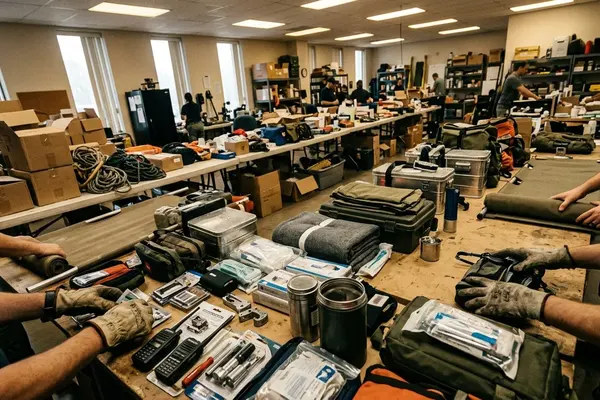
Keep Usable Medical Supplies Moving to the Clinic
Consider an illustrative morning before a camp clinic opens: a storekeeper checks a dressing carton against its stock card while the clinical lead reviews the day's expected workload. The carton appears on the balance, but its condition, expiry date, and availability for wound care still need checking. Their comparison establishes what the clinic can actually draw before triage begins.
The operational priorities are straightforward: forecast demand, account for replenishment delays, protect product quality, and record every movement. These controls connect clinical decisions to purchasing, transport, storage, and dispensing. A delivery completes only part of that chain.
Replenishment Starts Here
Maintain a shared item list, current stock balances, realistic replenishment lead times, visible expiry information, and a named person responsible for initiating each replenishment request.
The shared list starts with treatment protocols authorized by the host health ministry. Clinical and supply personnel reconcile those requirements with the packaging available from pre-qualified medical wholesalers. This establishes a common language for prescribing, ordering, counting, and issuing supplies.
Build the Forecast Around Services and Actual Use
Begin with the services the clinic is authorized to provide: consultations, wound care, maternal care, and other locally approved activities. Translate that service plan into an approved list of medicines and consumables. A service requires its supporting materials as well as its principal medicine or procedure item.
For established services, consumption-based forecasting draws on clinic use and clinical activity. Central-store issues provide useful movement records, but an issue voucher records a transfer. Supplies issued to a clinic may remain on its shelves, be used in treatment, or appear later as a documented loss. Comparing issues with clinic balances and dispensing records helps distinguish these possibilities.
Restore Demand Hidden by Stockouts
A stockout can make recorded consumption look deceptively low. When oral rehydration salts are unavailable during increased diarrheal illness, low store issues cannot establish low patient need. The forecasting worksheet should identify the interruption and reconstruct demand from outpatient utilization and morbidity records, using fully stocked periods to establish the consumption baseline.
Set the stock buffer against the whole replenishment interval: internal requisition approval, export clearance, transit, customs inspection, and local quarantine release. Freight time alone understates the period the stock must cover. Record the assumptions behind the buffer so the next reviewer can revise them when access or delivery conditions change.
Consumption-based estimates become less predictive during sudden population influxes or acute epidemic declarations. Those conditions require an immediate shift toward morbidity-based caseload calculations rather than extending a historical average.
Convert Clinical Requirements into an Order Suppliers Can Fill
Separate clinical validation from commercial sourcing. The medical coordinator confirms the generic medicine, dosage form, and strength; the supply logistician maps the approved requirements to supplier packs and freight schedules. This division keeps purchasing decisions within the clinical specification.
Each order line needs the following fields:
- Item identifier and generic product name, where applicable
- Formulation or technical specification, including strength where relevant
- Pack size and explicit ordering unit
- Requested quantity expressed in that ordering unit
- Delivery location and required arrival date
Distinguish individual dispensing units from supplier packs before calculating quantities. A dressing pack, a box containing dressing packs, and a master carton represent different counting units. Both the request and the supplier confirmation should make that distinction visible.
Net requirement equals target stock minus usable stock minus confirmed inbound quantities expected in time. Express all terms in the same unit. Exclude expired, damaged, quarantined, or otherwise unavailable supplies from usable stock. A delayed shipment belongs in the calculation only if its confirmed arrival still meets the requirement.
Keep Specifications Intact
Supply personnel may adjust quantities to supplier pack multiples. Changes to medicine strength, salt form, or sterile packaging specifications require written clinical approval before the order proceeds.
Protect the Shipment and Control Its Release
Shipment planning starts with product requirements, then tests them against the route. Weather exposure, handling conditions, transit delays, and receiving-store readiness all affect whether supplies arrive usable. The receiving team needs shipment details, expected arrival information, the purchase order, and the documents required to reconcile the consignment.
Cold chain arrangements require product-specific storage conditions, appropriate transport equipment, temperature monitoring, and an excursion-response procedure. No single temperature range covers every medical product. The receiving team must know which conditions apply to the actual shipment before accepting it into available stock.
At arrival, the storekeeper and pharmacy supervisor hold newly offloaded supplies in a designated staging area while they complete the checks.
Check Before Shelving
- Match the waybill and packing list against the approved purchase order.
- Verify product identity, specification, pack size, physical quantities, batch numbers, and expiry information.
- Inspect packaging and review transport temperature records where required.
- Document discrepancies and hold damaged or temperature-questioned products apart from released stock.
- Record the release decision and receipt before transferring accepted supplies to their storage locations.
A temperature excursion requires assessment under the product-specific procedure. Recording arrival alone does not establish that the affected product remains suitable for use.
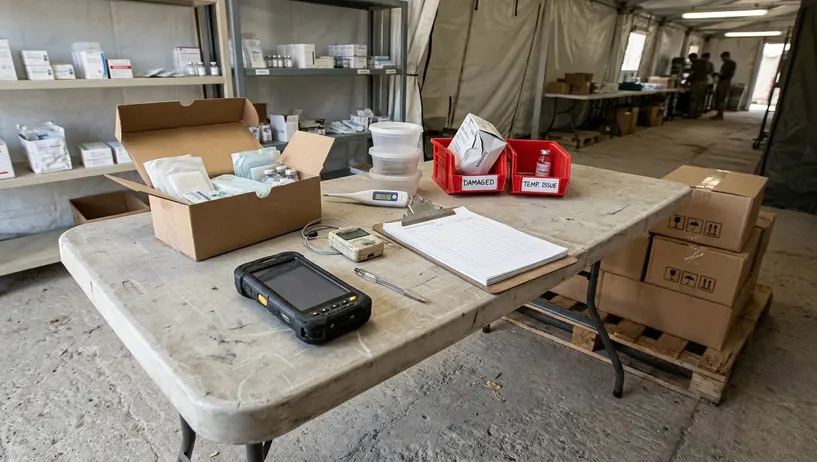
Keep Stock Cards Aligned with Usable Shelf Stock
A stock card provides the movement history behind an inventory balance. It identifies the item and counting or ordering unit, then records the date, receipt or issue reference, quantity received, quantity issued, running balance, and person making the entry. Batch and expiry traceability belongs either on that record or in a clearly associated register.
Update records when movements occur.
Physical counts test the recorded balance. When a count reveals a discrepancy, investigate and document it through a separate authorized adjustment; silently replacing the balance destroys the movement history. The discrepancy and the action taken should remain visible to the next person checking the stock.
Arrange released batches so earlier-expiring usable stock is issued first, with later-expiring stock behind it. Keep labels accessible for inspection. Cleanliness, security, and product-specific environmental conditions matter alongside shelf order: supplies need protection from water, pests, and direct exposure. Pallets should remain clear of floors and exterior walls to reduce moisture contact, pest damage, and heat exposure.
Expiry visibility also supports replenishment decisions. Stock that will expire before its planned use cannot provide dependable coverage for the full forecast period.
Reconcile Store Transfers with Availability at the Bedside
A central store can hold adequate supplies while a clinic shelf stands empty. Compound-level availability and point-of-care availability therefore need separate checks. A delayed internal request, an incomplete issue, or an unrecorded receipt can interrupt treatment even when replenishment has reached the site.
Handle clinic replenishment as a documented transfer: an authorized request, a verified issue, acknowledgment of receipt, and corresponding updates to store and clinic records. Dual-signature requisition vouchers establish the handover between the central store and outpatient dispensing shelves.
During the clinical-logistics review, compare clinic dispensing records with central-store issue vouchers. A rise in antimicrobial issues warrants examination: patient attendance, prescribing changes, clinic stock accumulation, and unrecorded wastage have different implications for the next order.
Use a shared review sheet to track stockouts, unusual consumption, losses, pending deliveries, and approaching expiry. Assign each unresolved item an action and responsible person. This keeps the review focused on decisions rather than unsupported performance claims.

Work a Dressing Shortage Through to Replenishment
Hypothetical case: wound-care activity has increased, a dressing carton has water damage, and the scheduled replenishment truck is delayed. Verified usable stock cannot cover expected demand until the revised arrival date. The following sequence provides a practical worksheet for resolving that gap.
- Count both locations. The storekeeper counts sterile dressing packs in the central store while the clinic lead checks dressing-room stock. Both record quantities in individual packs and identify batches and expiry dates.
- Separate the damaged carton. Move it to a marked quarantine area and exclude its contents from available stock pending assessment. Keep it physically separate so potentially compromised sterile barriers cannot enter the dressing room.
- Reconcile the records. Compare the counts with stock cards, clinic balances, and transfer vouchers. Document discrepancies and authorized adjustments without erasing previous entries.
- Confirm the delivery date. Obtain the supplier's revised arrival information and update the inbound record. Remove the original arrival assumption from the coverage calculation.
- Calculate the uncovered requirement. Use current wound-care visits and expected dressing use through the revised arrival date. Subtract verified usable store and clinic stock, plus any confirmed supply arriving within that interval.
- Arrange the bridging supply. Request an authorized inter-facility loan from a neighboring health post for the uncovered requirement. Verify the dressing specification, usable quantity, expiry, and dispatch arrangements before confirming the transfer.
- Receive and issue the loan. Check packaging, quantities, batches, and expiry on arrival. Record the receipt and loan obligation, then document the transfer to the dressing room and obtain acknowledgment.
- Reconcile the delayed delivery. When the truck arrives, complete receipt checks, update the usable balance, and document repayment of the loan. Carry the observed wound-care demand and revised replenishment interval into the next dressing order.