In this Article
- Lasting Sanitation Starts After the Pit Is Dug
- A New Ring Is a Repeating Waste Job
- The Hose Ends at the Receiving Point
- The Plant Still Has Both Fractions
- One Clock for the Pit and the Bay
- A Display That Follows the Load
- Draw the Waste Path Before the Slab
Lasting Sanitation Starts After the Pit Is Dug
Sludge management capacity determines whether emergency latrine expansion delivers lasting sanitation. I hold that line whenever a layout is scored by how many cubicles went in during the first fortnight.
Containment buys time. Emptying keeps the facility usable. Treatment and a controlled final destination address the waste after removal. Those three jobs are the test of an expansion.
In August 2017 the Rohingya influx reached Ukhiya and Teknaf. Emergency WASH planners put shallow pits in first, to prevent open defecation across densely populated hillsides while settlements spread through the Kutupalong-Balukhali expansion. Downstream desludging was deferred. Pit exhaustion then forced the turn toward centralized sludge management.
Emergency communal latrines built with shallow 1.5-meter concrete-ring pits in high-water-table zones required emptying within 7 to 14 days of commissioning. Sphere humanitarian standards cap emergency communal latrine usage at 50 people per facility, and that cap drove the rapid first installation across those expansion sites. The 50-person figure is the emergency communal standard that set sharing during that surge. Fill time on a 1.5-meter ring in a high water table is the number the sludge service has to match: days, not a construction season.
A hillside of new drop-holes can look like coverage. On this ground it was a short clock, restarted every time a ring climbed.
A New Ring Is a Repeating Waste Job
The operational shift is from installing emergency facilities to repeatedly managing the waste those facilities accumulate. Construction is a push. The waste service is a cycle.
Containment is the volume that holds excreta until a crew removes it. Fecal sludge is the accumulated mix in that volume: feces, urine, anal-cleansing water, grit, and rubbish. It is thicker and less predictable than wastewater moving in a sewer. Desludging is the removal of that accumulated sludge so the containment can be used again.
High groundwater and monsoon runoff send an unsealed pit into the footpath drainage beside it. Concrete ring-slab chambers and buried plastic holding tanks keep the same load in a known volume, off the walking surface. The comparison is about where the waste sits between visits, not about which superstructure photographs better.
Emergency containment chambers typically range from 1,000 to 3,000 liters in effective volume. Inspection belongs on the schedule once accumulated sludge reaches approximately 0.3 meters below the drop-hole slab.
Check the Freeboard
Look when sludge sits 0.3 meters under the slab. On a 1.5-meter ring at emergency communal density, that freeboard arrives inside 7 to 14 days of commissioning.
Every added latrine adds continuing work: inspection, emptying, a route the crew can actually walk, and downstream capacity that can take the load. The early containment challenge in this case was exactly that list. More cubicles meant more of it, on a repeating clock, while the settlement was still expanding.
Opening day is the start of the service. Installation finishes on opening day — the waste job starts the same morning.
The Hose Ends at the Receiving Point
Emptying a latrine moves the sludge, and it moves the responsibility with it.
The sequence is short. Inspect the containment structure. Prepare the work area. Select equipment that couples to that pit. Transfer the sludge into secure containment. Deliver it to a receiving point. Skip a step and the cubicle is still full, or the load is loose on a path.
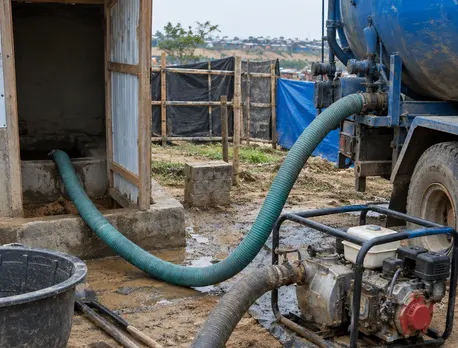
Approach routes, hose reach, sludge consistency, equipment maintenance, and receiving capacity can each stop an emptying service. On the terraced settlements the access comparison is blunt. Field teams initially tried standard truck-mounted vacuum tankers. Steep, unpaved clay footpaths and narrow shelter spacing kept the vehicles out, so the service shifted to portable diaphragm pumps, intermediate transfer tanks, and manual relay teams.
Portable vacuum and diaphragm pumps face suction-head limits of 3 to 4 meters vertically. They lose effective prime over horizontal hose runs exceeding 50 to 60 meters across terraced slopes. Manual transfer relays use sealed 20-liter to 60-liter high-density polyethylene drums, carried along bamboo boardwalks, to reach road-accessible 1,000-liter intermediate bulk containers. A pump that cannot hold prime, and a drum line that can, are different services sharing one pit.
On terraced camp hills, once vertical lift passes 4 meters, desludging capacity has to be read at the handoff rather than off a pump curve. The downstream treatment intake bay needs daily volumetric buffer, or the crew is only queuing sludge the plant cannot take that day.
Gravity-fed transfer pipelines and motorized vacuum tankers fail on unconsolidated sandy slopes steeper than 15 degrees, and during monsoon when unpaved tracks cannot support axle loads above somewhere around 3.5 metric tons. Specify drum corridors and short hose runs for those slopes before anyone orders a tanker route.
Prime Lost Uphill
Treat 3 to 4 meters of vertical suction and 50 to 60 meters of hose as the working envelope. Past that, stage sealed drums to a 1,000-liter intermediate bulk container.
Emptying puts usable volume back in the pit. The material in the drum or the intermediate container is still untreated fecal sludge. Whoever receives it holds the next obligation.
The Plant Still Has Both Fractions
Treatment continues after collection and transport. In the Cox’s Bazar case that next stage is a set of functions with their own weather, hold times, and dependencies, not a single machine at the end of a road.
To handle the surge of collected waste, WASH coordinators stood up multi-stage plants combining anaerobic baffled reactors, planted drying beds, and lime treatment. Temporary emergency lime-stabilization trenches sit beside that arrangement as the rainfall-sensitive option: heavy rain fights dewatering in an open trench. A baffled reactor, a planted bed, and a lime step divide the work so one wet afternoon does not have to finish every job.
Settling or dewatering separates liquid and solid fractions. Pathogen reduction is a further function, with its own hold and its own check. Equating the split with safety skips the step that actually changes the risk.
Hydrated lime stabilization requires the sludge mixture to stay above pH 12 for a minimum of 120 minutes to achieve rapid pathogen inactivation before trenching or drying. Unplanted sludge drying beds require 14 to 28 days of retention per batch under dry-season solar conditions. During the June-to-September monsoon that retention extends beyond 45 days. A bed schedule written for the dry months will stack batches once the rains arrive, unless the operating plan already carries the longer stay.
Both fractions need further treatment and a controlled destination. Split the tracking. Follow liquid effluent for biological oxygen demand and pathogen reduction before discharge. Follow dewatered solids for thermal treatment, storage, or alkaline stabilization before burial. A single “received” mark hides which fraction is ready to leave the site.
Track Each Fraction
Liquid effluent: biological oxygen demand and pathogen reduction before discharge. Dewatered solids: thermal treatment, storage, or alkaline stabilization before burial.
One Clock for the Pit and the Bay
A well-maintained latrine can still sit inside a failing sanitation service. Sweep the slab, repair the door, and the cubicle looks ready. If collection stops, or treatment cannot take the load, the pit fills and the facility returns to the problem it was built to limit.
Overflow-triggered calls and zone-based manifests are two ways to time the same trucks, pumps, and drums. Uncoordinated morning deliveries produce severe hydraulic shock at the receiving bay. A zone manifest spreads those arrivals so the plant sees a day it can treat, not a queue it can only store.
Camp coordination cells adopted zone-based manifest systems after treatment plant operators reported those shock loads. Desludging teams log manifest handoffs across a 48-hour dispatch window so receiving bays stay inside their daily cubic-meter hydraulic intake. The window is the shared clock between the person at the pit and the person at the bay.
Practical responsibilities line up along that clock:
- Inspection of containment condition and freeboard
- Emptying requests tied to a zone, raised before the slab is wet
- Equipment readiness: pumps that hold prime, couplings that seal, drums that close
- Receiving arrangements that expect the volume and the hour
- Treatment operation that can take the day and still hold lime time and bed time
Operational records worth keeping cover containment condition, emptying activity, destination, equipment faults, and spills. Treat that list as operating practice for a service that shares one plan between collection and treatment.
A Display That Follows the Load
A camp sanitation exhibit should make the visible latrine the entry point to a larger waste-management system. The superstructure is what visitors recognize. The lesson starts when the pit fills.
A short checklist is enough to test the display:
- Where is waste contained?
- How is it removed?
- Where does it travel?
- What happens to the liquid and to the solids?
- Who maintains each stage?
If a panel or an object cannot answer the next question, the chain has a gap, and the gap is the teaching point.
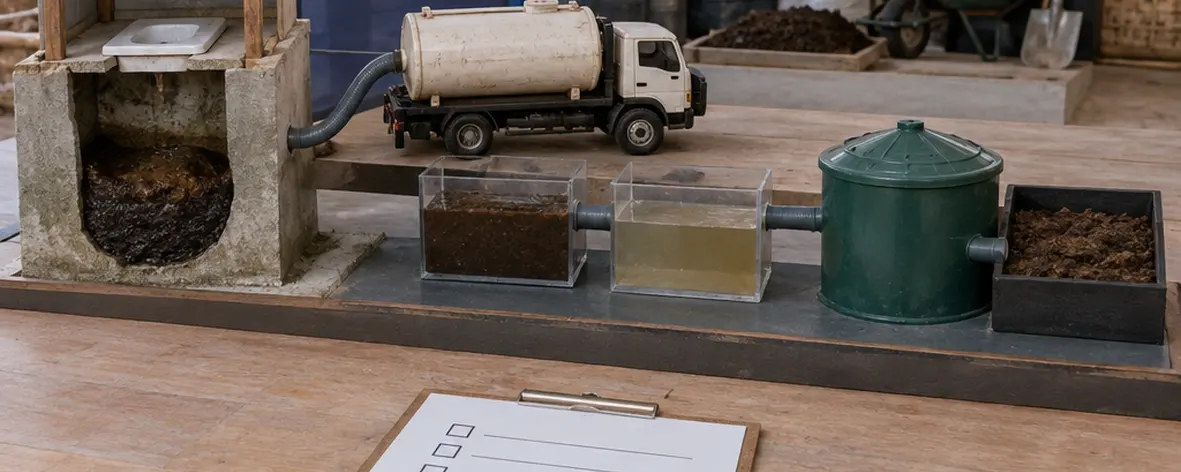
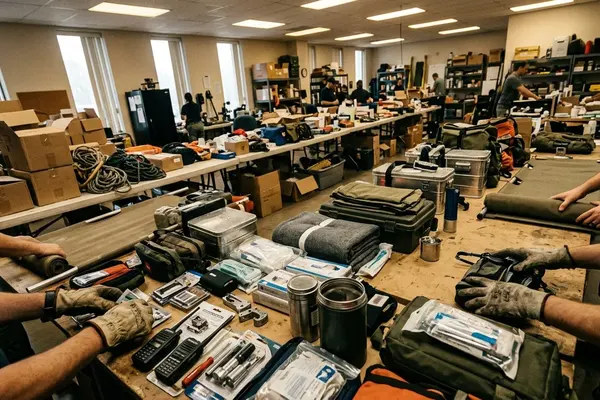
Curators of this kind of public display put camlock hose couplings, suction wands, and personal protective equipment beside the latrine superstructure so visitors trace the labor after the pit fills. A standard 75-millimeter camlock suction coupling and heavy-duty nitrile gauntlets are the physical interface where operators manage pathogen exposure during a pit-to-drum transfer. Ordinary hardware, placed in order, does more than a label that says “sanitation.”
A latrine outlet, a short transfer hose with visible couplings, and a closed collection container, set in one physical sequence, show containment and transfer as connected acts. Treatment is a further stage. Hoses, containers, and treatment components earn their place by demonstrating those connections. Isolated objects, however carefully lit, teach a storeroom.
Draw the Waste Path Before the Slab
Rapid construction creates recurring responsibilities that continue after a latrine opens. That is the lesson this case keeps handing back.
Post-response evaluations led humanitarian logistics teams to put desludging access corridors and treatment land allocation into initial site-planning templates, rather than treating waste removal as a secondary maintenance phase. The linked requirements stay short: accessible containment, safe emptying, secure transfer, functioning treatment, and a controlled final destination.
Coordinated site planning reserves a 15-meter minimum buffer between communal containment pits and groundwater extraction tube wells, and dedicated 2-meter-wide footpath corridors for hose and drum transport. Those two reservations are how the chain gets a place on the ground instead of a promise in a meeting.
Students should be able to walk that chain without a missing handoff. Educators should teach the handoffs themselves: freeboard, prime, the receiving bay, the split between liquid and solids. Responders should plan the operation before the slab is set.
Do not commission the next communal latrine until its emptying corridor, transfer method, and treatment slot are already drawn, staffed, and able to take the load on day 14.